
The first Super Bowl I ever watched was Super Bowl XXII. In the UK it started in the middle of the night. I watched the first quarter and Denver were ahead 10-0. I fell asleep. I woke up at halftime. It was all over. What the hell happened? Doug Williams is what happened. So, I watched the highlights the next day. Recently, I watched the game in full for the first time. Having done so, I feel that not watching the second half live was a good choice by teenage me. The whole second half was Washington grinding out the game.
At the start of the 1988 season, Channel 4, who were the TV channel that brought the NFL to the UK, started the season by reminding us of how the 1987 season finished. Their highlight reel of the Washington v Denver Super Bowl was set to a song called Deul by a German synth-pop band called Propaganda. My strongest memory of Super Bowl XXII is from that musical montage.
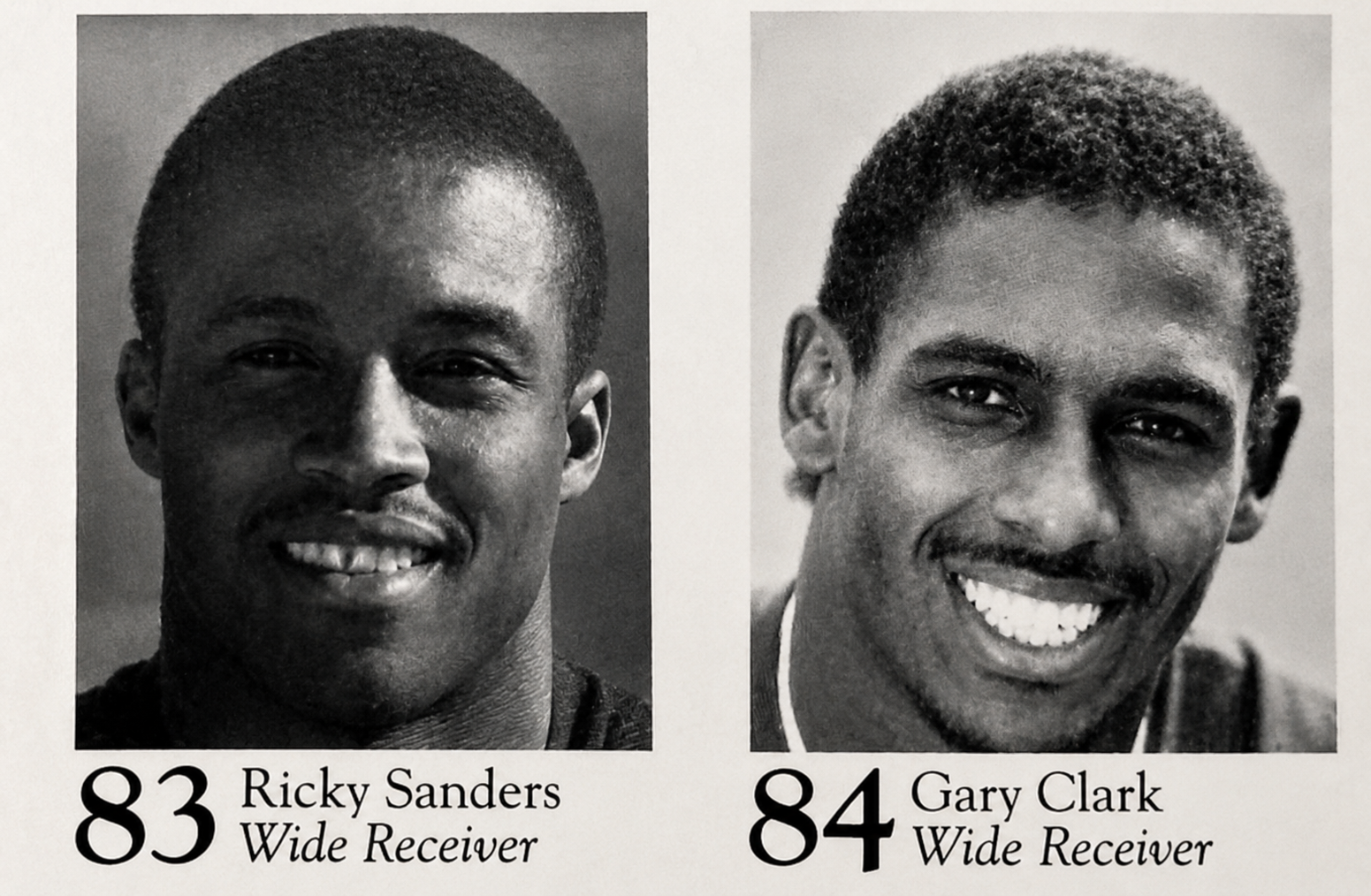
Perhaps the image that stuck with me was the fourth touchdown that Washington scored. There was the 80 yarder to Ricky Sanders that got the whole thing started. There was a crossing pattern to Gary Clark at the goal line. There was the long run by Timmy Smith. I always remember it to be 58 yards. But my memory could be wrong. Google it if you must. And then there was the fifty yard lob down the middle, on a post pattern, to Gary Clark. Best of the bunch. Gary Clark. Nothing but style.
The only thing is it wasn’t Gary Clark. For years I remember that touchdown being Gary Clark on the post. It was Ricky Sanders. I remembered the play for all those years because it was the best looking of all the touchdowns scored that day. I remember the way Williams dropped the ball right in there. It sort of slides over Sanders’ shoulder and into his hands. He doesn’t break stride. From certain angles you see the ball and player meeting at the perfect intersection. The pass didn’t even have to be as accurate as it was. Sanders had his DB beat easily. There’s a smoothness to that play that I love. Funny how I could remember all of that, keep that with me all these years but over time replace in my mind which player it was that made the catch.
One thing you’ll read over and over, in some form or another on this website, is that what is most important is that these words exist and it doesn’t matter who wrote them. I could apply that to great Super Bowl catches. You like to credit the right person, but what sticks is that the fifty-yard bomb happened and it stayed with me for all these years.
There were times when I was younger, throwing a ball in the park, when I’d watch a ball in flight and find myself appreciating the spiral, the timing, the way I had made my friend fall on his butt, and then, when it was time to catch the ball, I’d be too involved in that moment to remember to make the catch. To this day, watching any game where there’s a drop, I feel it’s such a crime against a well thrown pass. As I’ve grown older, I feel my concentration has improved a lot, but also, there’s a feeling of being totally in the moment, focused from start to finish. You can enjoy the moment only when it’s over.
I doubt anyone catching a ball would even notice. I don’t think Ricky Sanders would have done much more than feel the excitement as he crossed the goal line. He wouldn’t have thought, “I wonder what that looked like from the crowd.” I say that, but you see these days that players coming into the locker room are shown plays on tablets, for instant responses, and that’s become a thing now. But, it’s still not instant reaction.
In pickup non-contact games of football or just slinging a ball around in a park, I’ve made a few over the shoulder catches and a handful of directly overhead catches. They are the hardest catches to make. I have no idea how cool it looks but I know it feels great. One time we recorded our game on the Bourne Green, our local park, and I remember watching back a clip of me running a crossing pattern and just sticking one hand out and catching the ball in stride. It looked like a suction cup on the end of my right arm had just grabbed the ball out of the air. I kept on running, never breaking stride. At the time you only have a vague idea of what you did. I don’t think you could ever express how it felt.
Why would you express how it felt? It reminds me of a comedy sketch from 90s sketch show Smack the Pony.
A woman interviewing an English footballer after scoring the winning goal, asks:
Tell us about that goal. How did that feel?
He replies: Well, Darren played a great ball in, and I was just lucky to be on the end of it
Yes. But what did you feel?
Well, you see, Darren played a great ball in, and I was just lucky to be on the end of it.
Yeah, but what did you actually feel? It’s a semi-final, penalties looming and you score in the last minute to win the game. How did that make you feel?
(You know what’s coming!)
Darren played a great ball in, and I was just lucky to be on the end of it
The punchline is that the interviewer finally breaks him down, and whilst crying he asks, “Why do I hate my mother? I shouldn’t hate my mother.”
On reflection, although it is funny to think of a stereotypical English footballer trying to come to terms with having any feelings at all, I actually doubt anyone, man or woman, could know exactly how a moment felt. We’d all feel something, and maybe what this is all about is that we don’t know how we feel.
Even though it was decades ago, in a meaningless game with friends, I know I felt something when I made that one handed grab. I know Ricky Sanders felt something on all those Super Bowl catches. The fans in the stadium felt something. Sport is emotional. Emotions don’t just come in happy and sad. There’s a lot on that spectrum. There are probably sports psychologists making a living because of that.
The writing brain does not shut off, not even at sports events, not at concerts, not whilst watching a play, or even watching TV. That doesn’t mean it ruins all those things. It can happily co-exist in my head with whatever I’m doing. That’s how I find myself at Wembley looking for a replay that I can never see.
Wembley October 2010, the 49ers are playing the Broncos. I’m in the cheap seats, high up, corner seat. It’s actually a good view. Although I always have an issue with Wembley seeming so far from the pitch, up high I feel like I have a view that you can’t get on TV. At the end of the third quarter Denver runs a simple flea-flicker play. Kyle Orton hands off to Knowshon Moreno, who turns around and flips the ball back to Orton who launches it deep right to Jabar Gaffney for a 38 yard score. Except none of it counted, as the play was called back for a chop block on Moreno, which to this day I think was a bullshit call. (Can we please remember that I am a sports fan and a writer and as much as I can talk about the beauty, psychology and philosophy of the game, I can still bemoan a bad call from sixteen years ago. Seriously, Moreno knew nothing about it. The defender fell over him, and he gets called for a chop block?)
I remember watching that pass from where I sat and although, watching it now, it didn’t look like the arching moonball that I remember it to be, I still feel that, from my seat, with my view, I was seeing it like no one else was. Being high up, it felt like for a moment or two I was on the same level as the ball. An optical illusion. No way did Orton throw it that high. And my first instinct was to look to the big screen for the replay, but I was never going to see a replay of what I’d just seen. I’m never going to see that same view again. The most memorable thing that day was something that didn’t even count and the best view of it only survives in memory.
That’s an experience that feels like it wholly belongs to the spectator. For one moment I said, “This is why you watch live sport. It’s for this view.” It wasn’t for the atmosphere. The London games have a weird vibe because it’s ninety thousand people and they aren’t all fans of the two teams who are playing. Many are there to experience a sport they know nothing about. Nope. I wasn’t there for the atmosphere. I wasn’t there because I cared about the result. I was just there for live sport and because Wembley is a half hour tube ride from my home. Sat there watching a play that never officially happened felt like a good reason to be there.
In 2022 I went to a college game in Dublin. Nebraska v Northwestern. We were sat next to the Northwestern marching band for that one, and it was a lot of fun to see some of these kids living their best lives. I remember when Northwestern iced the game with an interception with under two minutes left on the clock. I remember the guy who was the hype man throughout the game, a skinny little guy, who’d spent the whole game getting everyone fired up. I remember him jumping in the air, punching the air, at the very moment the play happened. From my seat, that was my view, my lasting memory, the uniqueness of live sport for me in that moment. How that moment played out is dependent on what was in your eyeline at the time.
These are snapshots, moments, all perceived in different ways, existing only in my memory, somewhat preserved here in writing. The one thing that, in recent years, has fascinated me, is this idea that got into my head and won’t go away, of there being the strangest of relationships between what is seen and what is perceived. Above all else is that no one perceives exactly the same thing and yet we still connect over something shared but not ever fully understood. There’s a collision of what is and what is perceived.
I think this is most evident to me when I think about concerts. I can be watching someone playing guitar on stage, and I think of how it must feel to be able to do that. But then I think, do they know how amazing it is to do what they are doing? Can they ever know from the audience's side of things how it feels to be enjoying what they do? I imagined a guitarist envying the viewer and the viewer envying the artist. Does that artist ever get to enjoy what they do? I suppose this idea landed because of how people would often say, “I’d love to be able to play guitar like that.” Don’t tell me you’ve never heard someone say that or said it yourself. The notion can apply to sports too, but you don’t hear it as often. I think that’s because of the complexity of some of the activities we’re talking about. Someone could feasibly suggest, “I could run down the field really fast just like Ricky Sanders and catch a ball.” But when they watch David Gilmour play the guitar solo in Comfortably Numb then that becomes something magical that they feel they’d never produce with a million years of guitar lessons.
The very idea of Gilmour playing that, of an audience watching that, makes me think of the emotional wallop that the audience gets. Does the guitarist get to feel that? I’m conjuring up an analogy of the man on stage being able to hose down the onlookers but he himself can never get soaked. David Gilmour of Pink Floyd never knows what it’s like to hear David Gilmour of Pink Floyd. Maybe? You’d have to ask him. Yeah. Someone please start an interview with him with that question. This is the one scenario where I feel that there is some sort of feedback loop between onlooker and object, and it’s a mass of confusing emotion. If you left a concert and someone wanted to interview you to ask how you felt, it would be a struggle. We all put out the usual platitudes. It’s a script we know how to use.
One fascinating thing I’ve seen recently is a little-known musician by the name of Philippe Nash, with an extraordinary sound that’s folk grunge with some rock-cello thrown in for good measure. I saw a clip of him playing in a bookstore, and the whole emotional performance being met with silence. It’s as though the music, the sounds, the emotion, the feelings, all exist, regardless of who applauds or whoops at the end of the song. The song is still great. It’s still the same song. The music exists, regardless of how it’s perceived. It’s a tree falling in the forest when no one’s around. There’s a sense, when at a concert, that the collective response is there to share this idea that something happened, even if we don’t know what it was, even if we can’t name it.
What really throws a spanner in the works is when you hear exactly the same song and feel nothing. Best case example is me at Coldplay in Crystal Palace circa 2005. I’d watched and enjoyed the same songs on TV only a few days before, but when seeing it live there was a feeling of disconnect that made it one of the worst live experiences I’ve ever had. I couldn’t work out why I felt more connected watching their Glastonbury performance on TV and felt absolutely nothing at a live venue.
It almost feels like any given experience is dependent on perception and participation. Here’s an interesting clash of performer and audience. During a Monday night home game in October 2023 Jahmyr Gibbs had a coming out party against the Raiders. It was the first time that he really exploded on any team. His 152 yards on the ground was just a hint at what was to come. The occasion will always be remembered for a 27 yard score that ended with him jumping into the crowd. The only thing was, he didn’t quite make it all the way up the wall and ended up being hauled into the crowd by a fan, a slender looking blonde woman who bear hugged Jahmyr the rest of the way, whilst play by play announcer Joe Buck shouted “Come back, Jahmyr, come back!”
Something we’ve all thought before is, “I wish I’d been there.” I thought of how if I was there, I'd not know if I'd be jumping around like everyone else or just taking selfies, shyly trying not to be in camera shot. But, watching it on TV imagining being there, I felt that if I was there then there would be an interesting combination of not instantly reacting and following what others are doing. It wouldn’t feel like a genuine emotion. It would feel like I was copying everyone else's actions to create the appearance of emotion. Watching the game on TV, distanced from the real thing, I was able to have my own personal fist-pumping moment of celebration alone.
I’ve avoided reading much more about it. But, having quickly checked it out, the woman’s name is Katie Six. She must work out. Most interesting, in light of what I’m saying here, is that in interviews she has said that it felt like “a crazy, out-of-body feeling.” Even when you’re there, you’re maybe not there but, failing to fully experience something is not a loss. It’s the cost of participation.
There’s a middle there, in in that Jahmyr Gibbs scenario, in that excited mesh of people, where artist and audience collide. Although it’s more a case of the artist literally crashing the audience’s world. And in the middle of all of that, no one knows how the other feels. It’s a unique moment. It’s unframeable chaos.
Beyond our, albeit somewhat unreliable memory, only writing and photography stretch that moment out in any meaningful way. You could interview Katie Six from now to the end of time and nothing is going to encompass the moment like the photo of her the moment she successfully heaved Jahmyr into the front row. Arguably, all this type of thinking should stay bubbling underneath, only ever glimpsed at, because you couldn’t live in that state of mind and function. But there will be times when you see something or remember something. It doesn’t even matter if you remember right, or if you get the details wrong. You see it and feel something and the air, charged with whatever fuel sparked it, the whole moment is loaded with feeling. It’s enough to make you scream and shout and jump up and down. And for a moment there was really something there. And then it’s gone.
Except it isn’t. You remember the moment and talk about it and relive it and it never goes away. I have a friend who will talk to me about the 1990 NFC Championship game, again and again, as though it were the first time we’d discussed it. I met an Atlanta Falcons fan in a sports bar in London and talked to him about the infamous Super Bowl loss where they blew a 25 point lead and lost in OT. His friends at the bar said, “Is he talking about 28-3 again? We talked about the Julian Edelman catch and how each time you watch it, every time, you think that surely the ball hit the ground. It didn’t and every replay shows that. That guy is still feeling something and always will. So, all these moments exist in memory, in photos and in writing. Maybe that’s all writing is, a place for thoughts and memories, somewhere for them to go, because they have to go somewhere. Someone somewhere is thinking hard about Super Bowl XXII and trying to remember who scored the best-looking touchdown that day.
For the record: Gary Clark definitely scored the best-looking touchdown of Super Bowl XXVI. Oddly enough, a beautiful over the shoulder grab, in the right-hand corner of the endzone.
Where next?
→ If you want to explore how a moment can be experienced whilst simultaneously being observed, analysed and turned into a story, Life Is Not a Pop Video
→ If you want to explore how creativity, performance and meaning can exist independently of how they are received, The Noise Coming From Philippe
→ If you want to explore how interpretation shapes what we see and whether meaning exists in the event or in ourselves, Chubby out of bounds at the one yard line to win the game
If the writing resonates, stay with it.