
The Margaret Atwood appreciation society
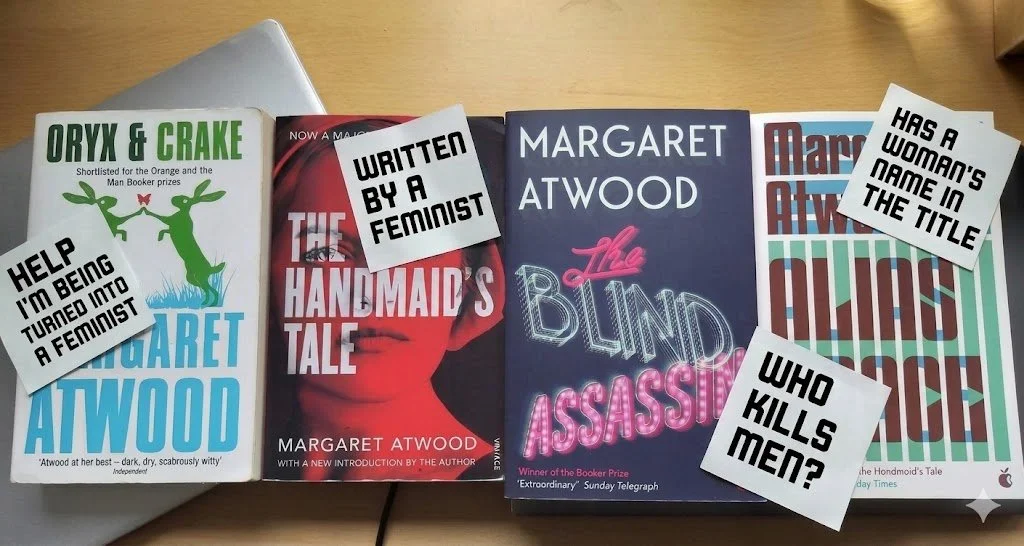
When I told a friend that I was watching The Handmaid’s Tale on Amazon Prime, he asked, “Isn’t that like punching yourself in the dick over and over for an hour at a time?”
The prejudice in this case was more to do with the reputation of the novel and the ideas about the author.
I avoided Atwood for years, not because I didn’t like the feminist approach, but because I didn’t like the feeling of being bashed over the head with it. That is the misconception that my friend also had. It’s the one that a lot of people may have if they’ve heard that the author’s best known novel was a work of pure feminism. “I don’t wanna be told about how bad us mens is!” But that’s not what The Handmaid’s Tale is. For me it’s a depiction of a dystopian world where all the things wrong in the world have gone wrong to the Nth degree and fascist idealism is once again the enemy.
I can’t argue that a novel set in a society in which women are enslaved to produce children for the ruling classes has nothing to do with feminism. I’ve clearly drunk too much of someone’s Kool-Aid if I think I can seriously ask for evidence of feminist ideas in The Handmaid’s Tale and then act surprised to find that the novel is built on them. I can’t say with a straight face “I hadn’t even noticed that feminist angle that you’re talking about.”
What I can argue is that it is so much more than a novel about feminism. And the main objection I have is that some literature is too good, too important, to be boiled down to being labelled as just one thing, when it is so much more.
The idea that aspects of gendered life exist in Handmaid’s Tale, not only as a warning, but as an exaggeration of the reality we live in, is something that society is happy to overlook. Is being named Offred, because you are the property of Commander Frederick R. Waterford, any different to taking your husband’s last name? And it wouldn’t work if Offred was Ofwaterford. That’s too near the reality we live in to be noticeable, let alone remarkable. Also, Serena Joy Waterford takes the title of Mrs Waterford. Offred is definitely not Ofwaterford. That would be too much like being Mrs Waterford and all that would do is reinforce what we already have in society. Where what we really want is the distortion of our way of life that drives home the point.
The idea of apologising for being male in a patriarchal world is not something that comes from the text, it comes from preconceptions of the novel. The reality of Handmaid’s has more in common with Orwell’s 1984 and Burgess’s A Clockwork Orange. Gilead, as a fictional country, is the gravity well for our worst inclinations. By design, the existence of Gilead is a result of all the bad choices a society could make, given the options on the table in our world at the time of writing.
That runs deeper than feminism.
Offred has memories of her mother being a pornography burning protestor for women’s rights. Yet she herself has a more level-headed view on the matter. Considering the state of the world, considering the existence of Gilead, pornography is the least of our troubles. And in turn, the people running Gilead use porn as a scary reminder of how wrong the old ways used to be. Offred seems to never have plans to be a feminist freedom fighter. She just wants her freedom.
It’s a no-brainer to point out that Gilead’s male dominated world can be seen as a thinly veiled swipe at male society. And that’s a feminist angle to be taking. That’s where you get me started on the whole, “it’s in the text” argument. In this case it’s more a case of insisting that the reader takes the whole text into account and not pick and choose from it.
If you are going to say that The Handmaid’s Tale is only a work of feminist ideology because the text says so, then you’re going to have to deal with the idea that the text tells you other things too. It tells you men and women are complicit in how women are treated. Gay people and priests and anyone else judged to be not quite right are also hanged to death on the wall in Gilead. Cruel and unusual punishments are delivered by the Aunts, the women charged with the care of the handmaids. You see the ruling class rule by fear and ritual. Handmaids have to act and speak a certain way. Being different is not tolerated. If you’re greeted by another handmaid with “Blessed day” then you’d better respond with "Blessed be the fruit" or “May the Lord open" or "Under His Eye," or otherwise draw attention to yourself and have others think of you as a dissident.
Sex is turned into a passionless ritual. Just as the Nazis attempted to turn genocide into an industrial, almost mechanical, function in their society, Gilead turns rape into a necessary step to ensure its own survival. The justification is cold and monstrous and clearly gives us more to think about than feminism. If the meaning is in the text, then you don’t get to ignore half the text just because one part fits a familiar argument.
The presence of sexual violence or female oppression does not automatically determine what a story is. In A Clockwork Orange, rape and violence are rampant, but the novel’s deepest concerns lie elsewhere. Handmaid’s has the issue front and centre.
Ok. It’s a little bit feminist-y. Perhaps my personal issue here is that from a twenty-first century reading, I think there’s a shift in exactly what feminism is and how it’s framed. The Handmaid’s Tale highlights exactly what feminism is to me. As readers there’s a coming together in agreement that you don’t treat people like this. And you acknowledge that certain people are treated in a way that is dangerously close to what is being depicted and you don’t like it. That line of thinking was probably way ahead of its time in the 1980s. And labels stick.
It is one of the hallmarks of this website that nothing is ever about one thing and that in the end everything is a human story. None of my sports articles are purely about sport. Hell, they sit in a difficult no-man’s land of being too sporty for non-sports fans and too flowery for hardcore sports fans who just want to know “Who won the Golden Boot in the 1990 World Cup?” (It was Salvatore "Totò" Schillaci and I can still see his passionate fiery goal scoring celebrations clearly in my mind). It might seem like my whole existence is about pointing out that nothing is as simple as it seems. But, much of the time it just isn’t.
American Psycho is only about a serial killer, as long as you don’t stop to realise that you get pretty far into the novel and no one’s been murdered. Animal Farm is only about pigs if you ignore that the pigs seem to be set on behaving like people. At some point you have to be thinking that pigs don’t do slogans and commandments.
The interesting thing is that if you know nothing about the Russian Revolution and Stalin and Trotsky, you do have to go outside the text to get the full meaning of the novel and to understand the whole thing is actually the Russian Revolution played out by pigs. Which, when you put it that way, does sound ridiculous. The text contains signals that point beyond itself. But those signals are still in the text. So much so, that you’d still sense it was about power, corruption, and control, without doing the research and knowing the whole Russian backstory.
That’s the best example I can think of when it comes to going outside of the text to find more meaning, in a good way, in a way that the author intended. That extra knowledge does take Animal Farm beyond what’s on the page. When you go fishing for meaning that isn’t there, that’s when your interpretation gets truly distorted. In the case of The Handmaid’s Tale, the meaning that was heaped on it, by those that didn’t even read the text, distorted the view of the author herself. Margaret Atwood does indeed identify as her own kind of feminist. That does not mean that every work by her is a feminist piece of work. I think if readers start with The Heart Goes Last or the Oryx and Crake trilogy, they’d have a different idea of the type of author Atwood is.
When it comes to living outside of the text, the extended Handmaid’s Tales, as they happen in the TV series, shows a progression of the ideas of the novel. The novel is like a Rosetta Stone, for all that comes after it. The DNA of the original is there and there is so much that people can take from it. Part of what they might take is that oppressing anyone is bad. It just so happens that women get oppressed a lot in this one.
I’m reminded of my copy of Anna Karenina, which had this blurb on the back of the book:
Anna Karenina is one of the most loved and memorable heroines of literature. Her overwhelming charm dominates a novel of unparalleled richness and density. Tolstoy considered this book to be his first real attempt at a novel form, and it addresses the very nature of society at all levels – of destiny, death, human relationships and the irreconcilable contradictions of existence. It ends tragically, and there is much that invokes despair, yet set beside this is an abounding joy in life’s many ephemeral pleasures, and a profusion of comic relief.
Or you could go for: It’s about an extramarital affair that goes very wrong. Life and literature should be far more difficult to explain than that.
Where next?
→ If you want to explore who gets to decide what stories actually mean, The Beauty and Power of Words — Part 6: Who the hell am I to be writing any of this?
→ If you want to see how meaning and interpretation can become more powerful than the events themselves, Chubby out of bounds at the one yard line to win the game
→ If you want to understand why meaning in art can’t be reduced to systems, labels or surface interpretation, Could an AI do this?
If the writing resonates, stay with it.