
You saw Chuck Weatherspoon
In my mind this is an epic collision of memories, with high levels of visceral emotion. It connects through the decades, shaping certain loves and fixations. It’s embedded in its time and place, wrapped in young adulthood, surrounded by cultural touchpoints in an age of pubs with air thick with smoke and all the energy in the world. It has everything and nothing to do with the Waterboy’s song The whole of the moon. Music is always a gateway in.
We start in the playground.
Arguably there’s an innate need to find others like you. It’s certainly a roadmap to being less lonely. Often, we idolise people because they champion something about ourselves that we want to see succeed in others. Growing up I liked Diego Maradona because he was a short stocky guy who could run around people. Sure, he had skills that no one else could even dream of, but recognising another short stocky guy generated a belief that superstars can come in your size and shape. Any kid in the Nineties who felt they were too short for much of what life asks of us, must have felt empowered by watching five foot three Muggsy Bogues play in the NBA. And he was good too. I liked that Mike Tyson was considered short for a heavyweight boxer at five foot ten. He was lethal and used his stature to his advantage. Usain Bolt may be the greatest sprinter of all time but traditionally sprinters were often shorter, more powerful and less lean. Britain’s Linford Christie looked like a solid rock of muscle, perfect for the explosiveness needed for sprinting.
Growing up watching Rugby there was always a clear division between backs and forwards. The backs were the heroes. They were lean, quick, skilful and scored all the tries. The forwards subdivided into “tall” and “wide.” If you were tall then you’d be in the second row. If you were wide and short, basically, built like a square, you’d be a in the front row. Back row players were always regarded as craftier and tenacious. Number Eights, at the back of the scrum were always thought of as natural ball carriers. That said, New Zealand’s Number Eight, Zinzan Brooke dropping a goal from just inside the halfway line in a Rugby World Cup semifinal lives as a moment of sheer ridiculousness in world Rugby history. Big men weren’t supposed to demonstrate such skill. No one told Zinzan.
I was never skilled like that. Most of us aren’t. But at a young age, one thing I found I could do was dodge. If I was made for anything, dodging and accelerating was it. “Nuts and bolts,” that was my game. For those that never played organised sports, all we have are a handful of moments, memories of doing showy things in an arena that no one will remember. Nuts and bolts was basically a tag game, sometimes referred to as British Bulldog. We played on a concrete netball court, where falling over was not a good option. The gist of it is that one person starts as the bulldog, the person tagging those trying to run from one end of the court to the other. When you are tagged you become a bulldog too and play out the rest of the game tagging other people. The “nuts and bolts” version differs only slightly in that the bulldog calls someone out and that person has the chance to declare “nuts” and makes a solo run or “bolt” and everyone rushes out. Looking back, I’m sure that the only reason to say “nuts” is to showboat and beat someone one on one. Surely “bolts” allowed you the protection of being lost in the crowd. If you said bolt, then everyone else could become your unwilling blockers.
Anyone who knows my love of American Football will see where this is going. For me football, and in particular, the role of running backs, was all nuts and bolts to me. You like in others what you like in yourself.
I remember the ridiculousness of the strategy where you just tried to go around the bulldog. And I mean way around. You could get chased out wide and then wider and wider until you’re off the court (as kids we clearly had no concept of “out of bounds”). Imagine a sweep play in football where there is no out of bounds. Think of Ray Lewis chasing some undersized receiver to the locker room. Sometimes you’d then double back and try doing the same thing on the other side. You’d either turn the corner eventually or just run out of puff and get tagged. Sometimes, on the other hand, you had to make moves. Quickness and shiftiness were needed. I think I was quick and shifty. I remember one time getting home to the safe zone with some moves and a flourish of a jump at the end and one of my classmates gave me a “Whoop.” I didn’t know that running past people could make people whoop.
My most memorable sports days were played out on the Bourne Green, the local park, with friends kicking a round ball around, with jackets and jumpers for goalposts. In that arena everyone got a moment to shine. Kicking a ball around was probably not what I loved the most. Sprinting to catch up to someone to nick the ball off them was more my thing. And then a few years later it would feel more rewarding to sprint to catch up to a different kind of ball thrown deep down the middle of the field and catch it in stride. I still think that there’s no feeling like it.
The American brand of football had become my obsession. 1987 was a life changing year. Somehow, I found the time to get into a new sport, find music that reflected how teenage me felt, get thrown out of every class going at school, get punched in the head on two different occasions by two different teachers, get in a fair few school fights, and get drunk for the first time. It seems inconceivable right now that there could be so much going in in such a short space of time.
I stand by the music choices of the time. New Order and Joy Division will always be my musical first loves, and I love them as much today as I did back then. They were all mine. No one got me into them. There seemed to always be something that someone introduced me to. Daniel Trenor taught me chess and gaming. Paul and Ian Smith were responsible for me knowing anything at all about Star Wars. My love of Nineties Zeitgeisty fiction was a direct result of attending Doctor Clive Bloom’s lecture on Bret Easton Ellis at Middlesex university in the mid Nineties. Even my decades long love of American Football was started by my friend and neighbour Doug Campbell. Through Jimmy Smith and Ian Lynch, I not only had my first taste of booze, I adopted music that matched my headspace. Darklands by The Jesus and Mary Chain and The Head on the door by The Cure still stand as monumental pillars of my cultural upbringing. For those who don’t know and want to feel like a morose teen (either again or for the first time) Google those bands. Spotify them. Joy Division and New Order were all mine though. I found them. No one influenced me. No one said, “listen to this band.” That’s when you really connect. It feels like it’s just you and the band.
Imagine all those things meshing together in a teenager. Imagine having the time to discover all of it at once. In all that teen shitstorm, American Football seemed the one part that didn’t seem to fit. For me it makes sense. Music matched how I felt. Connecting with songs that people assumed appealed to teenagers dressed all in black, with their hair dyed black, and smoking dope did not preclude anyone from liking American football, despite what American teen movies will have you believe.
Tag football in the park, even more so than nuts and bolts in the playground, gave me a small arena to compete in. That said, I don’t know if we cared for the team win as much as we cared for individual plays. No one was keeping time. We played until we didn’t want to play anymore or it was too dark to see.
It was a small group of teens from Farnham in Surrey in the south of England, who followed the sport. You had to be somewhat of an oddball to be throwing a ball about in your local park. Something that’s so normal in the US was so niche in the South of England. I’ve memories of throwing a ball in Hyde Park, when I moved to London, and various Europeans, French and Italians and Spanish asking to join in and asking how you get a spiral on a ball. “How do you make it spin?”
I never threw that well to start off with. It was all wrist action for me. Getting a good tight spiral was no problem. Distance wasn’t so great. Remarkably, coming back to the sport as an older man, I found that I had to adjust my throwing action to accommodate an older body and I probably fling a football better now than I ever did in my twenties. I catch even better now too. I probably concentrate more. Sadly, my legs, once able to accelerate so well, won’t catch me up to any deep balls thrown down the middle of the field now. Back then, Richie Hawks could throw that ball, seemingly with ease. Sometimes you’d catch up to them and a lot of the time you didn’t. Hey. Even the NFL has an average of around forty percent completion rate on deep balls.
From 1988 and for a few years after it our teen years and young adult lives would be spent playing on the Bourne Green and watching late night NFL at each other’s houses. Doug’s place, Rob’s house, Richie’s house. And, with tongue firmly in cheek, we made up the legend of the Bourne Football League (BFL). See what we did there?
We grew from old teens to young adults, old enough to legally be drinking in pubs. We even had a late-night lock-in at the Bat and Ball Pub to watch Dallas destroy Buffalo 52-17 in Superbowl Twenty Seven . You have to remember that, due to the time difference, all Superbowl games I’ve ever watched have been through the night, usually ending at three or four a.m.
From 1988 onward we attended football games. We went to Wembley to see the pre-season games. They called it the American Bowl back then. We went to the World League games. We knew it was a farm league for players who weren’t good enough to make it to the pros, but we didn’t care. We had a London team to support. That seemed to matter. I still have my London Monarchs shirt, somewhere in the attic. We even went to our local team, the Farnham Knights. That’s real grass roots football in the UK.
One amazing thing we came across was when we found out we could go to see the joint practices between the two teams who were playing in that annual pre-season game. It was remarkably easy back then to just stroll into the Crystal Palace national sports centre and find yourself on the sidelines of the practice field. At the end of the practice you’d go to where the team buses were parked and wait for the players and ask for autographs. I don’t do autographs anymore. The last one I ever asked for was Barry Sanders autograph in 1993. Personally, I think the stories are better than the scribbles of autographs on old football magazines.
Barry was my idol. Barry is the reason I’ve been a Lions fan since 1991. I kicked around the league from 1988 without really being committed to one team. I liked the Dolphins. They were the first team I saw play. I liked the Bengals, as I had pulled for them in the 1988 season. Everyone loves an underdog story. But what I loved the most was watching running backs play full contact “nuts and bolts,” like I did as a kid.
The one thing that the 1988 Bengals had was a rookie running back called Ickey Woods. I think a lot of fans took to Ickey-mania and the Ickey Shuffle, his weird little dance in the endzone that really shouldn’t have been as big a deal as it was. Before Ickey, my running back of choice had been Timmy Smith, based purely on his Superbowl Twenty Two performance. But Timmy was and will always be remembered for just that one game. I’m not sure that picking a running back is the way to choose a team. In the end I chose the greatest running back ever. But before Barry I had Chuck.
Chuck who? I guess, outside of the University of Houston, no one has a clue who I’m on about. My old friend Richie Hawks would probably remember. But outside of Houston that would be it. In the UK that’s definitely it. I seem to remember Richie saying to me, “You got to watch this college game I recorded last night. There’s this one player at the University of Houston who just won’t allow himself to get tackled.”
What I saw was a bowling ball of a man, playing dodge, playing nuts and bolts. I have memories of trying to tell people, and these people did not care one bit about sports, about Chuck and how he wore number Twenty Eight and Twenty Eight was my new lucky number (and still is) and I would talk about how Chuck was a bowling ball and how he’d amazed me when I first saw him play and how he was one five foot seven, two hundred and twenty nine pound bowling ball of a running back and would not go down easily. In a run and shoot offence that we referred to as the shoot and shoot, Chuck was the guy that brought the excitement. Running was in the playbook, but the run and shoot was an offense that would happily call four passing plays in a row from the opponents one yard line.
There was something about watching Chuck play. The anticipation was as much a part of the show as the actual action. Barry Sanders has always had it and in modern times you’d pay to watch Boise State just to see Ashton Jeanty break a big play. You’d be waiting and waiting and then “boom” sixty yards and the crowd is on its feet.
Chuck did it differently, but you always got the feeling he was going to break one. He didn’t glide around the field, nor did he stride. That’s the Eric Dickerson model. He wasn’t a thumper or a battering ram, think Marshawn Lynch. And he wasn’t a burner with blazing speed either. But then again many backs just aren’t. Bo Jackson was an anomaly. Chuck however, he was a pinball in a pinball machine, seemingly constantly in motion. Again, we’re back in the playground and grown up me lived for people just doing things that no one else was going to do and doing them in way you’d want to do them.
I adopted Chuck’s number twenty-eight as my lucky number. Before people got so savvy with passwords, if ever you wanted to guess a football fan’s password, you’d only need to work out who his favourite sports star is. Much later, when I started reading Russian literature, I discovered that Leo Tolstoy was born on 28 August 1828 and adopted the number twenty-eight as his lucky number. You can only imagine how much of a rare audience you’d have to have if you wanted to explain, in any meaningful way, how and why you had the same lucky number as Tolstoy.
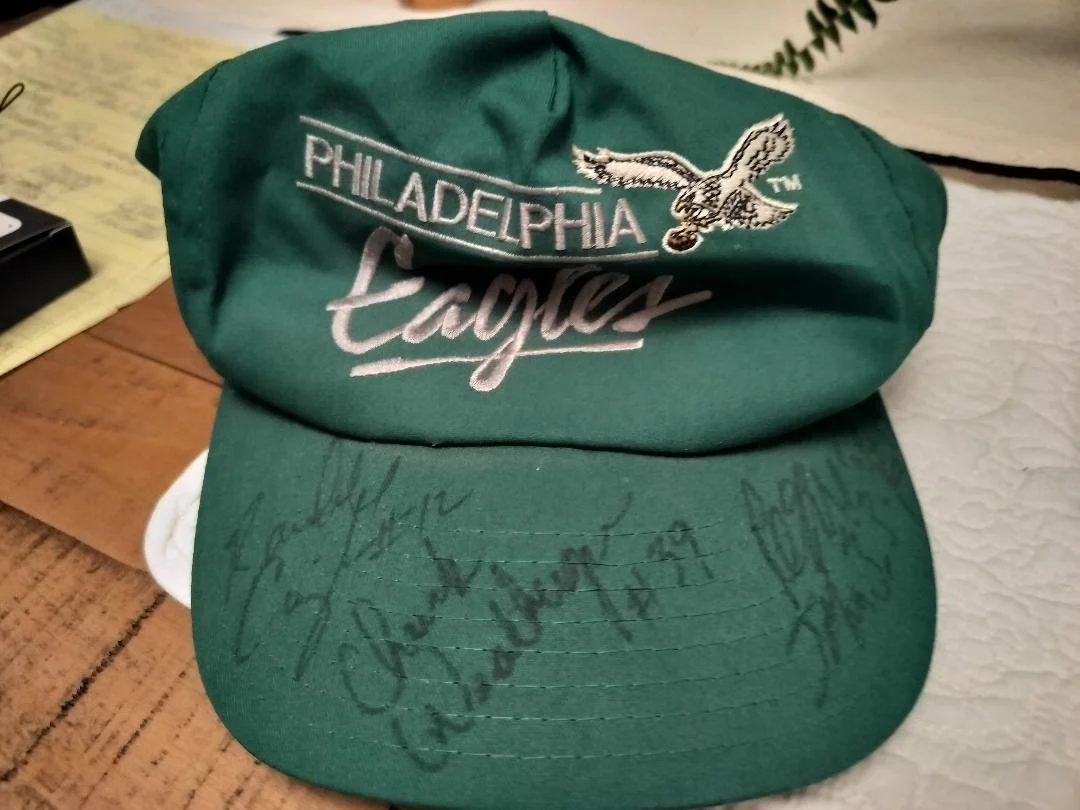
All of this is tied to a lynchpin of being in the Wheatsheaf pub in 1991. We’d just been to see the Eagles and Bills practice at Crystal Palace, on the week running up to the pre-season American Bowl game. One consequence of that trip is that I now have what might seem like the oddest piece of sports memorabilia, in the shape of a Philadelphia Eagles cap that is signed on one side of the peak of the cap by Randal Cunningham and on the other side it’s signed by Reggie White (Complete with Bible reference after his signature). And in the middle? Yep. Check Weatherspoon. To which, any football fan, before reading this, would say, “Who the hell is Chuck Weatherspoon?”
The Wheatsheaf was one of the most popular pubs in town for young people. Every Friday and Saturday it was packed out. It was central to our young lives. And I have this strong memory of watching Richie Hawks in the Wheatsheaf, playing a football arcade game. In those times you’d have all sorts of entertainment in the pub. They knew their clientele very well.
As Richie played his game, the Waterboys song, “The whole of the moon” played on the jukebox. There are certain songs that are markers for their time. That song was definitely one. Those who were listening to music in the early nineties, who know nothing about the Waterboys, and I’m included in this, would know that song. You couldn’t remember the time without remembering the music. And for me, all these years later, decades later, I can find myself listening to a random playlist and feel so connected to that time and place. As Richie sang, instead of “the whole of the moon,” he sang, “You saw Chuck Weatherspoon.” It made me laugh, and as much as I don’t like to sully a great song, I still find it hard to not at least think of those alternative lyrics. I think of how this is where I came from. Unemployed, no qualifications, in a pub, loving things that no one else around me loved or even knew about, drifting but for the moment feeling good because I had seen Chuck Weatherspoon. I think I might have told Chuck, when he signed my cap that I was a big fan of his and that I loved watching him play for the University of Houston. He seemed a nice guy. He didn’t have an NFL career. But then again, neither did Andre Ware, who played QB on the same team and won the Heisman in 1989.
It helps that “The whole of the moon” is one of those songs I think of as throwing everything in the universe at us, creating a sense of wonder with imagery of holding a rainbow in your hand, stretching for the stars with the wind at your heels, blazing your trail like a comet. All this balanced out with the mundane, squaring off the positions where the singer “spoke about wings,” whilst “You just flew.”
By the time we get to, “Unicorns and cannonballs, palaces and piers, trumpets towers and tenements, wide oceans full of tears, flags, rags, ferryboats, scimitars and scarves, every precious dream and vision underneath the stars,” you feel like every piece of Irish magic has been thrown at you. Even though they are not strictly an Irish band, there are strong Irish connections. I was surprised to find out that they weren’t Irish and that the front man, Mike Scott, is actually, a Scot.
American football gave me something I loved. It gave me an identity. All these years later, sitting in my garden office, I find myself playing The Whole of the Moon and singing “You saw Chuck Weatherspoon.” But I was singing it like it was the proper lyrics, without the silliness that Richie Hawks had given it all those years ago. There was something of a sense of exaltation in singing it, giving Chuck Weatherspoon and the memories of youth and hope and all the connections in between a higher standing. It’s nonsense to everyone else but has the impact of all of my own history being slowly tipped over my head and being meaningful and purposeful and connected.
About ten years ago I went to a work’s sports day. I took my football with me, thinking that maybe I could get someone to fling me some deep balls to run under. I’d been training my co-worker Arjun to throw and he’d got pretty good. I say that but he had a big old wind up of an arm action that made Byron Leftwich look like Dan Marino. (There’s one for those who study the mechanics of quarterbacks throwing actions). Not for the first time, I was low on options as to who might fling a football with me, but Arj didn’t let me down. He was throwing moon ball shots, and I was running under them, catching up to them, catching over the shoulder passes and those really tricky directly over your head balls that are notoriously the hardest to make. Nothing hit the ground. I stopped to think that I wish I’d had days like that when I was younger. I could barely walk the next day for all the sprinting around and I didn’t mind one bit.
I mentioned earlier that I’d never had the best arm in the world, but that I adjusted my throwing style later in life. That came about because of a happy accident. Having not thrown a ball for years, I met with a friend in Regent’s park. It had been some years since the sports day with Arj and since then I’d torn both calf muscles and that was the end of my sprinting days. I could still catch and I could still throw. Although, the first time I went to throw that day, I felt that I’d wrenched my arm in a way that did not feel right. The second throw was just as painful. The next throw I changed my mechanics and started to throw with a more over the top arm action, where previously it had been more of a three-quarters throw. I’d never thrown a ball so well.
Moving forward in time to last summer, I was flinging a ball around once again. It was another work event, and it started with just me and a couple of friends but something interesting happened. People from work who I’d never met before joined the circle and all wanted to have a go at this strange sport. Almost all of them couldn’t throw properly but no one cared and I didn’t try to teach them. I took a couple of breaks to talk to people from time to time, but mostly I spent four hours throwing a ball around to people half my age. People came and went. I didn’t.
As you get older do you still look for the things most like yourself? No one that day was like me. Or do you ever consider that maybe you might be entrusted to be the things that others should want to be like? You become the source of things people don’t know about and you make those things seem like wonders. I think of how good it felt to catch a perfectly thrown spiral from Richie and I wondered if those young people enjoyed catching the passes I was throwing in the same way.
Outside of superstition or tradition, a lucky number is nothing more than something you hold on to so as to remind yourself of the things that are important to you, the things you want to hold on to. They then become part of everything that got you to where you are now, so that when you hear a song from long ago you remember the childhood friends, the first time you watched a football player that meant something to you and that his name was Chuck Weatherspoon and it rhymed with the words “whole of the moon.”