
A Girl Raised on a Dying Planet
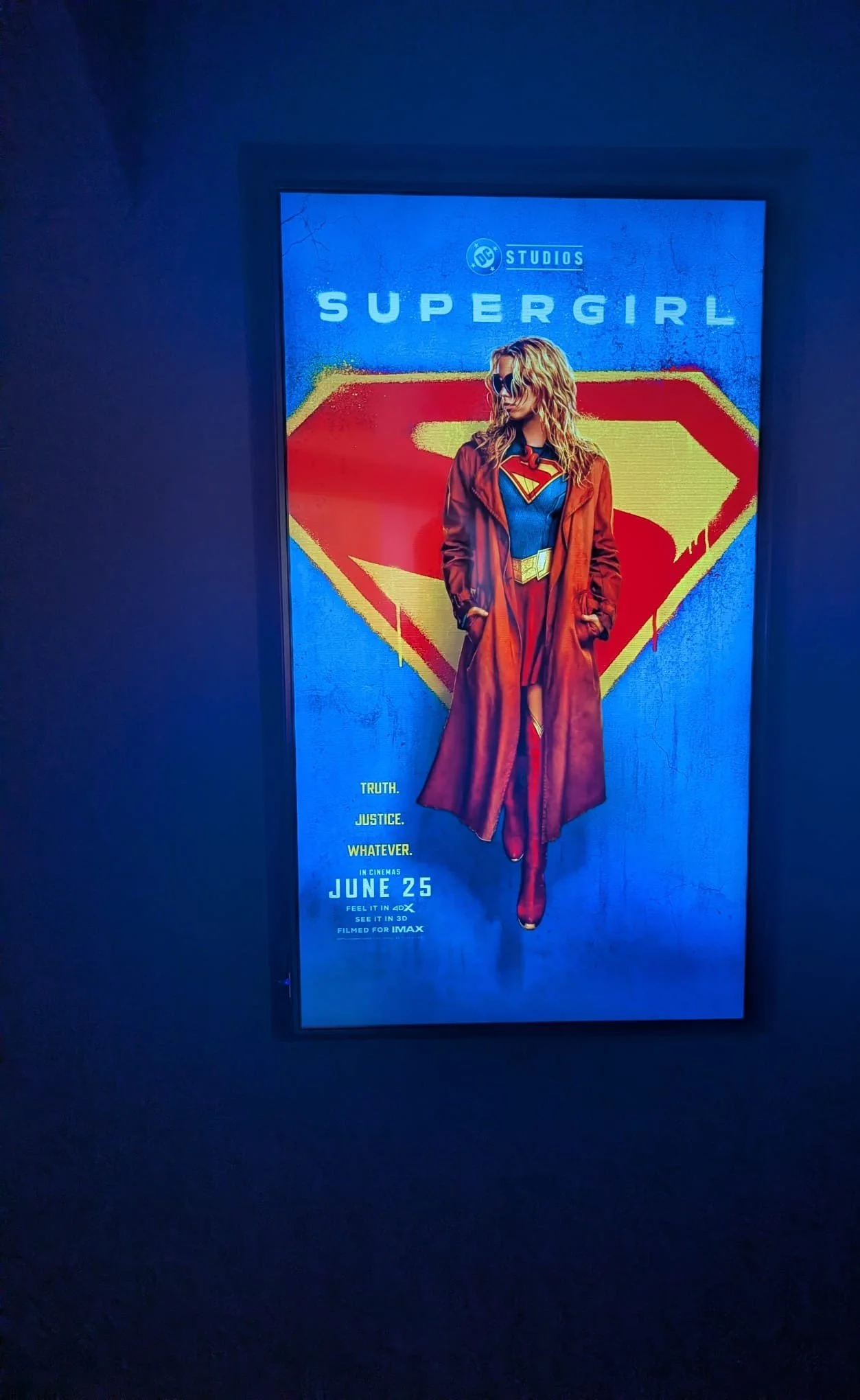
If it were the type of film to break the fourth wall, Milly Alcock’s Supergirl, when asked why she’s Supergirl if her cousin is Superman, she’d turn right to the camera and say, “That’s a damn good question.”
With Supergirl, Kara Zor-El, DC Comics came up with a different angle on the Super stories. From a writing point of view no one would want to write a superhero story with a brand-new character and make them anything like the character that set up the franchise. In other words, they made Kara’s story very different to Kal-El’s. As a result, you get two very different characters with very different reasons for doing what they do.
Craig Gillespie’s Supergirl film, based on the graphic novel, Woman of Tomorrow, by Tom King with art by Bilquis Evely, gives us a Kara-Zor-El with attitude and issues. As much as Melissa Benoist looked the part in the CW Supergirl TV series, her Kara was a giant loveable dork. That’s the character they went with. As Supergirl, she did stoic like nobody else. Milly Alcock on the other hand, gives us exactly the right Kara for the situation she finds herself in, for the story they are telling.
The story they are telling is of a Kara who was raised on Krypton and watched her world die. She witnessed people she loves die slow painful deaths. She’s jettisoned from her home and sent to Earth, to join her cousin Kal-El. How the hell is she supposed to feel about all that? It was different for her cousin, never knowing Krypton, never knowing what was lost, arriving on Earth as a baby, and most importantly being raised as Clark Kent. Kara never has that upbringing, that grounding. Clark makes the right decisions because of how he was raised. What drives Kara?
The fun thing is that at the start of the story, without any superpowers, what drives Kara is getting drunk on a planet with a red sun, where her powers do not work but the effects of alcohol do. Seems like the sort of reaction we could all relate to. Jeez, I remember the trauma I had moving from the town I lived in from the age of four to ten. At that stage of my life it was the only home I’d known. We moved to a new town. I went to a new school and found myself being bullied and feeling like I didn’t belong. I played up and I didn’t even have to go through having my home destroyed. So, we start this Supergirl story from a point of view that is relatable.
Milly Alcock’s Supergirl has attitude, but it’s earned. Unlike her cousin she can’t think of Earth as home. The people of Earth are not her people. Her people are gone. The only link she has to her past is her dog Krypto. Is anyone surprised when Krypto is poisoned and she goes John Wick on the galaxy to find the man with the antidote? People go to all lengths for their dogs. Although, with no spoilers intended for those who haven’t worked it out – it’s not entirely about the dog.
In the same way, it’s not really about Krem of The Yellow Hill. I thought this when reading the comics and it rang true watching the film, the enemy is not a big world ending threat. The enemy isn’t even an important character. Kara has just stumbled into how shit the galaxy can be and, at least in my reading, a major element of the story is that the story’s antagonists are essentially a gang of thugs. They’re not very clever either. It’s a personal story. It’s a story about loss and grief. Grief is the bad guy. Krem isn’t going to beat Kara. Grief might do it, but not Krem. You can’t tell this story with Brainiac or Darkseid as the villain. It would then struggle to be the personal story that the writers wanted.
It’s Kara’s story. Eve Ridley’s Ruthye Marye Knoll pushes the story onwards, with her quest for revenge. The idea that a thirteen-year-old wants to kill Krem does also highlight that Krem isn't really what needs to be conquered here. Ruthye’s thirst for revenge after she has lost her family, Kara’s sense of being lost and not knowing her place in the world, being lost in the arse-end of the galaxy, these are the things to overcome in the story.
On a planet with a debilitating red sun, with no powers, is a good place to start the story. It’s a good place to reveal character. Kara is trying to mind her own business. She wants to wallow in the red sun and numb herself. She doesn’t want to be involved in any quest for revenge, nor justice. What she can’t do is stand by when a huge alien mercenary steals a child’s sword. She is still good, despite her issues, despite not fitting in, despite having no allegiances with anyone other than Krypto. And “good” does not sit back when someone is stealing from a small child.
This is classic "a stranger comes to town" territory. This is storytelling 101. What you get is - the arrival of an outsider disrupts the natural order of things, disrupts the town’s status quo, both outsider and the town change because both the townspeople and the stranger go on a journey that forces them to change. It’s clear what has to change. There’s a lovely exchange between Ruthye and Kara. Ruthye asks Kara "When are you going to stop being angry? "Kara’s dry sarcastic, somewhat self-deprecating reply is, "Any day now." There’s your story right there. That’s a Kara thing.
In this mode of storytelling, we get a pluckier Supergirl than we’ve had before. She is not the naive version that Helen Slater played in the 1984 film, which felt very in line with the Christopher Reeve era. I think of Helen Slater saying, “Leave this place and do no harm.” I think Milly Alcock’s Kara would lovingly call that dork-like. That version of Supergirl did not seem to stop to think that her planet had been destroyed. It placed the character as innately good, from a good place, from Krypton. Slater’s Supergirl stoically got on with it. This is where Super-Lore gets murky though. It then seems like there is a reading of all things super in which Superman is good. Supergirl is good. Therefore, it must be that Krypton is good. But then again, Krypton produced General Zod. Not so good. We know it’s not Krypton that made Superman. We know it’s Kansas and Ma and Pa Kent that did that. Kara on the other hand is a product of Krypton. She had her childhood there. She was a child raised by Kryptonian parents. Her teen years and beyond, on the other hand, are born out of trauma and loss.
That’s what makes this a Supergirl story and not a Superman one. It’s not a case of using the same script and just gender swapping it. Different character, different issues and an entirely different feel to her film. I liked Kara getting drunk and going off the rails. I’d have taken it way too far and put in a scene where someone would have asked her, “What’s the “S” stand for on your chest?” And she’d respond saying, “Sloshed. It stands for sloshed. Sloshed girl. Right now, that’s me. I am sloshed girl.”
In reality, the script has her only drunk at the start of the film and who actually thinks that getting drunk on your twenty third birthday is unusual? And all your family and everyone you’ve ever known is dead, so it probably won’t be a very happy birthday at all. There’s no farm in Kansas for Kara to go home to for a birthday celebration.
It’s pretty darn clear from the first ten minutes that Kara is going through something. The film does not shy away from that. Kara is very much her own story. The true success of the character and the writers is that there is a goodness in Kara, despite awful things happening to her. She knows levels of emotional pain that her cousin never had to grow up with. How she deals with that pain, what she learns, how her story is completed, is not by defeating an arch nemesis, or saving the world, it’s saving herself, becoming more human, in a way that her cousin Kal never had to because he was fortunate enough to land in Kansas and be found by the Kents and only ever know that life.
As for the film? DC didn’t originally publish Woman of Tomorrow with the idea of how it would fit into a cinematic universe. Take your meaning from the story and don’t try to understand a film based on external factors. That’s how you end up with people questioning Sasha Calle’s hair colour in her short time in the role and forgetting how good she was as an (almost) unstoppable force of anger.
Kara Zor-El, I wouldn’t begrudge you some wallowing and quality drinking time under a red sun. You’d still be my hero, whether you get your shit sorted out or not. Real heroes have shit to sort out.
Where next?
→ If you want to explore why Superman’s greatest strength came not from Krypton, but from the life he lived as Clark Kent, A God Raised on a Farm in Kansas
→ If you want to explore how stories can become overshadowed by the conversations surrounding them rather than by what actually appears on screen, The Brie Larson Appreciation Society
→ If you want to explore why the meaning of a story ultimately belongs in the work itself, rather than in the reputation of its creator or the noise surrounding it, The Beauty and Power of Words Part 6: Who the Hell Am I to Be Writing Any of This?
If the writing resonates, stay with it.