
A moment of calm in the Red River Rivalry
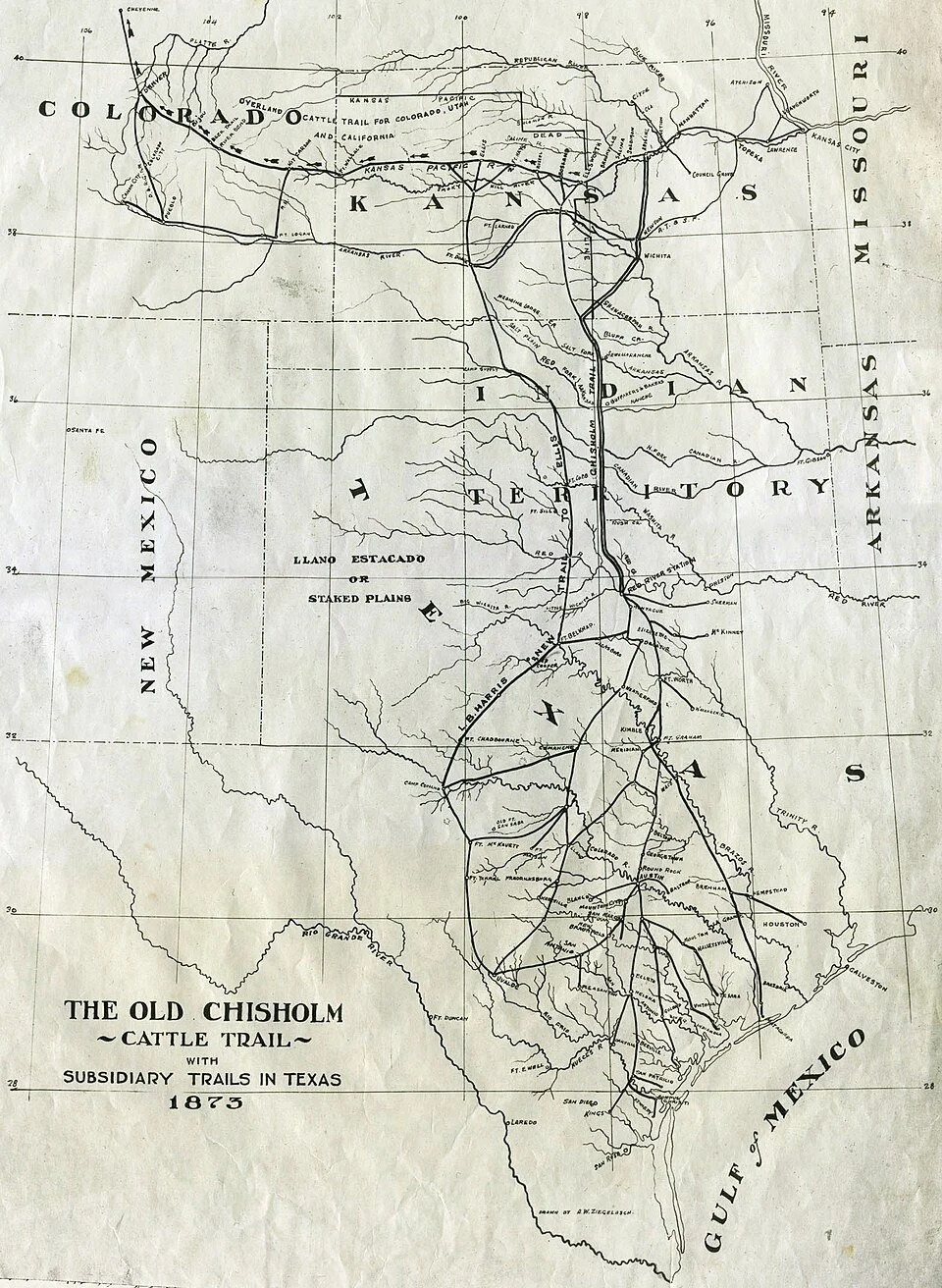
By Adrian W. Ziegelasch, 1893–1930, download and cleanup by Steve Meirowsky - http://www.kansasmemory.org/item/208627 (Kansas Historical Society), Public Domain, https://commons.wikimedia.org/w/index.php?curid=26451400
Being a Chisholm, I should be more into the Red River Rivalry, the college football matchup between the University of Texas and the University of Oklahoma. Red River. I think 19th-century expansion, cattle drives, the 1948 Howard Hawks film Red River with John Wayne and Montgomery Clift, based on the 1946 Borden Chase serialized story originally titled “The Chisholm Trail” and later published as “Blazing Guns on the Chisholm Trail.” Hey, that’s my family’s sweat and blood on that trail.
But really, I never knew that much about old cowboy trails. I knew my family name was connected to a famous piece of Western expansion. I do like that when I first heard of the Red River Rivalry, those words meant something to me. Red River, the very name in itself carries historical, geographical and cultural importance. It sounds like a border war on the dividing line of Texas and Oklahoma. Perhaps only “Bedlam,” the annual game, between Oklahoma State University and the University of Oklahoma, has the same sort of aura around it. And although everyone knows that THE college football rivalry is Michigan v Ohio State, so much so that they simply call it “The Game,” there is something about Bedlam and The Red River Rivalry that resonates as a part of American culture. Michigan and Ohio State just hate each other. Red River Rivalry and Bedlam feel like cultural touchstones.
This year the Texas Longhorns entered the game ranked number one in the country. The Oklahoma Sooners had dropped outside the top 25. So, it was number one Texas versus unranked Oklahoma. And you know what? Red River Rivalry just don’t care. It’s a fair fight come that game.
There was one thing that stood out to me at the end of the game. There was one camera shot of Oklahoma quarterback John Mateer during a timeout, and he was looking over to the sideline and gently nodding, and he looked so darn calm to me. The game was on the line but Mateer, who had been much maligned all season to this point, didn’t look worried or desperate or even like a man who knew the game was on the line.
Of course, the benchmark for cool was Joe Montana and the coolest legend still doing the rounds after all these years is the John Candy story. Playing in the Super Bowl XXIII, backed up at their 8-yard line and three points down to the Cincinnati Bengals, with just over 3 minutes on the clock, Montana, whilst in the huddle, noticed that tackle Harris Barton was extremely nervous and visibly shaking. To break the tension, Montana casually pointed into the stands and asked him, "Isn't that John Candy?" Sure enough, the actor John Candy was in the crowd munching on popcorn. Here’s the game on the line, the Niners needing to go the length of the field to score to tie or win, and the quarterback is spotting celebs in the crowd. The legend is that everyone chilled at that point. They of course methodically drive the length of the field and win the game. That’s always been about temperament to me. It’s not about being “clutch,” and it’s not about adrenaline pumping through your body. It’s not one play. It’s not the big play. It’s a whole body of work.
And no. No, I am not comparing John Mateer to Joe Montana. That’s never a part of what this is about. This is about cooler heads prevailing and what happens when they don’t. But if John Mateer becomes the new Joe Montana, then I’ll take any praise and people can think I’m some sort of football savant.
This week we saw one of the strangest ends to a game and it belongs in the good old category of bonehead plays and no one knows quite why it happened. I don’t think of it as “losing your cool,” or “a moment of madness,” or a “rush of blood to the head.” It felt like a case of “out of body experience” for everyone involved and the viewers.
The situation for anyone who doesn’t know: It’s overtime and Washington are in field goal range. There’s 50 seconds left in OT. Washington has no timeouts. They’re sat at the New York 26. There’s actually no reason to call a play, but if you really feel the need to call one then make sure you’re smart about what you call. For whatever reason, coach Dan Quinn doesn’t send out the kicker. Washington decides to call a running play and get another two yards. That in itself doesn’t make much sense. People start to feel that maybe they just want to make sure there’s no time left on the clock. Maybe. Weird but maybe. There’s a scenario where they miss the kick and allow enough time for New York to have one last shot. Paranoid but safe – I guess. So, now all you have to do is clock the ball. One snap. One spike. Just enough time left to attempt the kick.
With 24 seconds left in the game, Washington breaks the huddle and then everything seems to get sucked into the Twilight Zone. The ball is snapped with 13 seconds on the game clock. Daniels doesn’t spike the ball. He drops back, at which point reality seems to become distorted. The drop-back was somewhat of a stumble. The play was out of sync from the start. Daniels staggers after the snap, half-heartedly fakes a handoff and then runs a couple of yards to his left and then a couple of yards to his right and then goes down. I don’t think I’ve ever seen someone so lost on a football field. There’s not enough time to line up and go again and this time actually spike the ball. The game ends in a tie. Everyone but everyone is left saying, “What the hell was that?”
Nothing said after the game made much sense. The play was supposed to be either a quick out to gain a handful more yards or a spike to stop the clock. That does not explain what actually happened. I suppose it could be the case that no one wants to admit that they thought that they had one more timeout. Ruling out the embarrassment of forgetting how many timeouts they had, the only explanation the Washington Commanders leave us with is that the end of the game was just the perfect clusterfuck of miscommunication.
At least when Washington played the Philadelphia Eagles on December 26, 2015, Kirk Cousins chose to make his embarrassing blunder at the end of the half and not the end of the game. Long story short: at the end of the half he took a knee to run out the clock when what was called for was spiking the ball. Don’t get those two mixed up. One stops the clock, whilst the other does the opposite. Actually, I’ve just found out that the story is worse than I ever knew. The play that was called was a pass to the endzone. If the play wasn’t there, he was to throw it out the back of the endzone. Somehow Cousins’ brain translated that as “take a knee.” The clock runs out and the half ends with the scoring opportunity lost. At least we can excuse that away as a “brain moment” and nothing but.
Daniels took a moment and made it a confused mess. Cousins just did something inexplicably stupid. I guess the main difference between the two is that Cousins knew what he was doing. It was just not what he was supposed to be doing. Daniels seemingly had no idea what he was doing.
Back to the Red River: At the two-minute warning and the game tied, the Longhorns had a 55-yard kick to take the lead. It has the distance but drifts wide right. The only thing of interest on the Sooners’ next drive is that on a five-yard out pattern to Rocky Beers, Mateer seems to smile. Maybe he’s taking the time to admire the throw and catch. On the next play, with 3rd-and-4, he appears to be looking at the clock, perhaps thinking clock management. But they fail to get the first down, and OT seems increasingly likely.
Following the punt, Arch Manning got the Longhorns to the 50. Arch Manning is turning out to be a fan’s heart attack waiting to happen, his college career playing out like a rollercoaster ride. He was supposed to be Heisman-winning type good. The skills are there but it never quite seems to all come together. He’d thrown a pick-six to let Oklahoma edge ahead. He’d then brought them back level and now they needed 15 to 20 yards to position Texas for a game-winning field goal. There’s still 24 seconds on the clock at this point.
On second down, Texas have options. An incomplete or even a sack would be bad, but not fatal. Turning the ball over could be, though. Oklahoma bring the blitz on second down and under pressure Manning throws a pick. 19 seconds left. Okie ball at their own 40. This has become a border war between the 40-yard lines. One team just needs to go 25-30 yards to get into position to kick a field goal.
Isaiah Sategna then makes two incredible sideline catches to get the Sooners into range. The replay officials make them have to wait on both plays though. Both were close calls, but you can see that Sategna does get one foot in bounds. During the break, Mateer stood on the field quietly nodding, still looking as cool as… I’m sure he’s oblivious to the fact, and if you mentioned it he’d say he was just out there playing football. There’s 15 seconds on the clock. Position the ball and take your last timeout. And if you didn’t have any timeouts left, you could still put the ball in position and spike the clock, in just the same way the Washington Commanders didn’t.
Tate Sandell was ranked as the best kicker in the country in 2025. It’s still a pressure kick though, for anyone. 47 yards is not a chip shot. It was a long kick years ago. Ask Scott Norwood. By today’s standards it’s very kickable. But pressure is pressure in any decade.
The whole idea of messing with a kicker’s head before a big kick is a time-honoured tradition. I was in Palo Alto at Stanford Stadium in 1998, watching a game between North Carolina and Stanford that came down to the last kick. Stanford’s kicker lined up to kick a 20-yarder. North Carolina called timeout. You’d expect it. Both teams line up again. North Carolina calls their second timeout, giving the kicker even more time to think about it. I wonder if this really does put anyone off. Of course the boos rain down when North Carolina calls their third and final timeout. The guy who took me to the game, an old family friend, a guy who’s seen more football than anyone else in the stands, says to me, “Well, you can’t take them home with you.” On the fourth time of lining up, with no timeouts left for Carolina to call, the Stanford kicker kicks a wobbler that squeezes through the goalposts, just inside the right upright. Stanford wins 37-34.
You can’t do that anymore. The rules changed so you can’t call consecutive timeouts like that. One thing that has faded away is that very annoying strategy of coaches calling timeouts just before the snap. The kicker ends up making the attempt and it doesn’t count because a nanosecond before the snap there’s a timeout. I’ve always thought it was a complete dick move. It’s Lucy in Peanuts pulling the ball away from Charlie Brown just before he goes to kick it. “Icing the kicker,” making him think about it, is one thing. Then there’s just dicking around.
I have one memory of that tactic actually working. October 2016. Washington versus Cincinnati at Wembley Stadium in London. Dustin Hopkins is getting ready to kick a 34-yarder in Overtime to win the game. He kicks what appears to be the game winner and I’m already on the concourse before the ball even lands. It isn’t until moments later, when we’re almost at Wembley Way and on our way to Wembley Park tube station, that we realise that the game is still going on. Bengals coach Marvin Lewis had called timeout just before the snap. Somewhere Lucy was also pulling the ball to mess with Charlie Brown. Unlike Charlie Brown though, Washington gets a second chance. Hopkins misses. From outside the stadium, we can hear oohs and aahhs, but the game ends in a tie.
One of the reasons I think that coaches stopped calling those last-second timeouts is because after a while teams cottoned on and treated it like the first kick was a practice kick and the second one was the one that counted. Also, there were times when it backfired and timeout was called, the kicker swung and missed, only to realise that he had a second chance.
Back in Dallas for the finale of the Red River Rivalry. The Sooners are all staying away from their kicker. That too is time-honoured tradition, as much as icing the kicker is. And you have to wonder what goes on in any kicker’s head in that pressure-packed situation. After taking a down to position the ball on the preferred left hashmark, Oklahoma takes a timeout. You can see this as time for Tate Sandell to think about it or for him to get a few practice swings in. Sandell is on his own, but not too far from the rest of the team, swinging his leg. I think of the Buffalo Bills kicker Steve Christie and remember him saying after a game where the opposing team had called a timeout before a game-winning kick, something to the effect of “I’m from Canada. You can’t ice a Canadian.”
Sandell remains focused and is probably not surprised at all when Texas coach Steve Sarkisian calls timeout. During the timeout, on the Longhorns sideline Arch Manning looks more anxious than Tate Sandell does. The kick is never in doubt from the moment it leaves Sandell’s boot. As the Sooners run out on to the pitch John Mateer is noticeably all smiles. Another winning quarterback might be all fist pumps and headbutts. Mateer just looked happy. That’s a pretty good temperament to have in a big game at a big moment.
Where next?
→ If you want to see how a simple decision can reveal extraordinary skill, Chubby out of bounds at the one yard line to win the game
→ If you want to explore the strange space between what happens, what we experience, and what we remember, Not Gary Clark
→ If you want to discover what sport does to us when the clock runs out and anything still seems possible, J.J. Buchanan and this time there really isn't any time left on the clock
If the writing resonates, stay with it.