
Does a stuffed bear need to get the credit for his work?
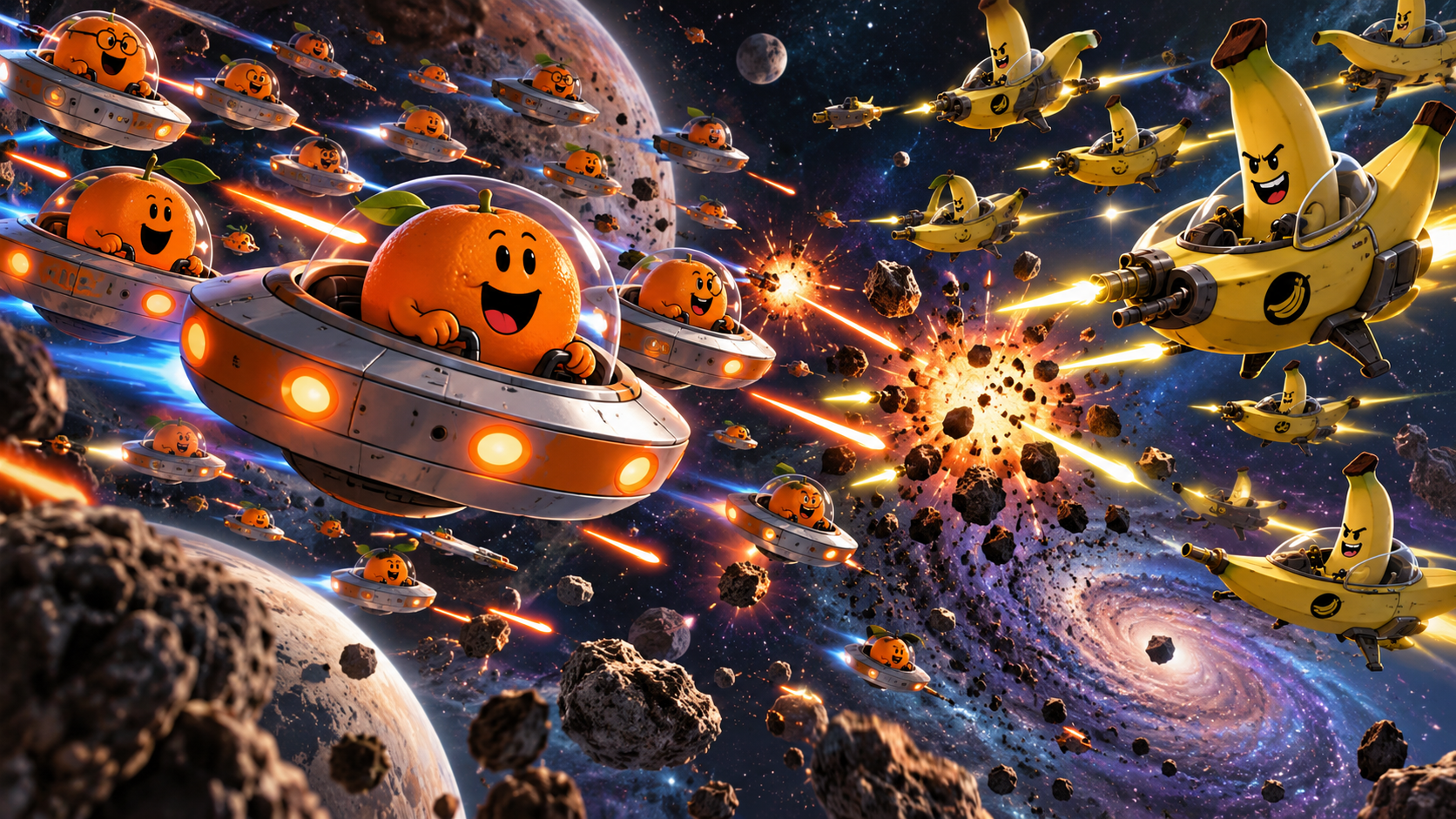
Created by....Oh, who gives a fuck? It's space oranges v space bananas!
I’m not short on thoughts when it comes to Artificial Intelligence. For some reason, as I go to write, I have thoughts of Ventriloquist David Strassman and Ted E. Bear. Strassman had many characters, Ted E. Bear was second fiddle to Chuck Wood. Chuck was crude and had a whip-smart sense of humour. Ted was what my dad would call wise-daft. He was slow and silly, but clearly able to come up with comments that were quick witted. That works in such a way that you ask if the character is really stupid or playing stupid. Don’t make me reference Homer Simpson and Hamlet in the same passage as Ted E. Bear.
I saw Strassman on stage in London in the 90s. It was a very uplifting show that also allowed for cynicism and current affairs. One memorable part of the show was Chuck Wood’s section where he fields questions from the audience specifically with the aim of proving that he’s clairvoyant. The only question I remember is someone asking, “Did OJ do it?” At that point in time OJ Simpson had been acquitted of murder but found guilty in civil court. “Did OJ Do it?” Chuck’s response? “Yes and No.” That’s the kind of show it was.
The other element of the show that people always remember is that the show used animatronics in a way that made the show and the characters come to life. The first time we saw Chuck sat alone on a stool and start to move all by himself was greeted by cheers. We knew the show involved animatronic work. No one in the theatre leapt up screaming, “it’s witchcraft.” At the end of the show there was a sing-along with Strassman and the puppets. I remember the song was All Together Now by the Beatles. Having seen some of the animatronic puppetry, one of the biggest cheers was for when Ted E. Bear comes to life and starts singing. A wooden doll like Chuck moving independently I could deal with. He’s probably easy to remote control. But floppy stuffed teddy bear coming to life and singing I was not expecting.
Great job David Strassman. But hang on. Did David Strassman make Ted E. Bear sing? What did he actually do? Who gets the credit for Ted’s performance? Ted? He’s a stuffed bear. The puppet operator, whoever that may be? Or maybe someone just flicked on a switch and the bear sings. Or do we give the credit to the person who came up with the idea? Does it matter who operated the bear and made him sing?
In that moment I did not care. It only came to mind decades later whilst thinking about recent debates surrounding AI and arguments about who created what. In the same vein, there’s the tale of the black crested macaque who took a selfie of himself in 2011. The news was full of debate about who owned the copyright to that image. I say, “Hey give it to the monkey and see what he does with the financial reward.” The thing is that I had to look up the wildlife photographer to find that his name is David J. Slater. With all due respect, what’s important is that the image exists. David J. Slater happened to be the man who set up the camera. What we remember is that the image exists. That’s what we care about.
I’ve said it before and I’ll say it again. Art is about choices. David Strassman chose to stick a mechanism in Ted E. Bear’s butt that would make him move at the touch of a button. The photographer chose to set his camera up where he might capture images of macaques. I feel that all the best photos I’ve taken have an aspect of luck about them. Does art count if it’s made by luck?
There is an element of luck when it comes to AI. You ask for something and hope you get what you want. And then you don’t and you ask for something else, something to be changed. Then you have a completely different idea inspired by all your messing about with your AI. Inspired? That’s an interesting choice of words there by me. Isn’t that something you’d ask an artist? What inspired this work? Well, I got the idea when I was messing about on ChatGPT. At that point do you totally discard the art and the artist?
Where do we go from there? Writers use Google for research. Google uses AI. A quicker way to get your research is to ask Google AI more questions about what you’re researching. Then you might write something and ask Google AI if this sentence you wrote encapsulates all that you had previously discussed. And then you use spellcheck to check you spelled “encapsulates” correctly. And then ask Google if you’re using “encapsulates” correctly in this sentence. And you stop and say, “I used to know words. But thank God I have an AI to remind me of all the things I’ve forgotten. And someone somewhere says, “Ah, so an AI wrote this?!” The way things are going I’d say that the black crested macaque taking a selfie has a better chance when he gets his day in court.
Is thinking of an idea and then asking for it to magically be made still art? It can be a genie or AI doing the building, but are you still the designer? Someone once asked me if I could ever see a time when all works of fiction were made by AI. I said that the problem with that is that people will still want to write. So, you write because you want to create. That’s why you write and then ask the AI to edit. I guess, if you had a passion for editing, you’d do it the other way round. And you’d still be the creator of what you produce because you came up with the ideas. The AI didn’t have the idea. You had to feed it the idea and instruct it. Either way, the desire to create is there. The means of creation are available now more than ever. The interesting question is really, not whether there will ever be a time when all fiction is made by AI, but rather if there would ever be a time when publishers choose to secretly and knowingly or unknowingly publish AI-written books instead of human written books. It is arguable that a populist stance on what a publisher chooses to publish, that may or may not already exist, is actually close to that model of publishing anyway. Think about it. A book that was one hundred percent written by an AI, to the extent that that is even possible, would incorporate aspects of work that already exists.
A publisher will ask: What genre is your novel? Who is it for? What's the premise? What's the hook? Who is the protagonist? What's the conflict? What's at stake? What are the themes? What's the tone? What is it like? Where does it fit in the market? Aren’t these the exact things you’d put into a description if you were asking an AI to make you a novel.
You could give the following spec to an AI:
Make me an action thriller. The intended reader should be readers of fast-paced, character-driven thrillers, particularly those who enjoy lone protagonists, conspiracies, investigative mysteries and action. The premise of the story should be that a man visits a small American town and whilst there discovers that a local disappearance is connected to something much bigger than anyone in this small town suspects. Our protagonist has no reason to get involved, but unfortunately for the people responsible, he notices things other people don't and the man has a moral code that won’t let him just walk away. He’s a former military investigator who lives outside conventional society and has a highly developed sense of observation, justice and self-preservation. Initially, he’s just passing through but once he realises someone has deliberately engineered a situation to conceal a crime, he wants to understand what happened and who is responsible. A conspiracy involving local officials, private contractors and apparently respectable members of the community, all of whom have something to lose if our protagonist discovers the truth. It’s one man operating alone, without institutional authority or reliable resources. Our man is reluctantly drawn into an alliance with a local woman whose missing brother may hold the key to the mystery. Their relationship combines mutual suspicion, respect and an increasingly shared determination to uncover the truth. Opposing them is an apparently ordinary businessman whose influence extends much further than anyone realises. Set all of this in a declining American town somewhere off the main interstate routes: diners, motels, empty industrial buildings, long stretches of highway and a community where everyone appears to know everyone else. The familiar landscape provides a contrast with the hidden machinery operating beneath it. Keep the tone suspenseful and the prose economical. The story should build its tension through observation and unanswered questions before escalating into physical danger. It’s our protagonist’s detached perspective that provides dry humour and allows ordinary details to become clues. The prose should maintain a fast pace while giving the reader the pleasure of watching the hero work out what everyone else has missed.
Look! With no disrespect meant towards Lee Child, you’ve made your own Jack Reacher novel!
Who can we sell it to and how does it fit into the market? If this is the first thing we ask, then there’s a good chance that we’ve actually already been making books like an AI would. We might already be Human AI Writers. The industry already treats creativity as the ability to fulfil a brief. If you are a truly unique voice, the worry is not that an AI could take your place, it’s that a publisher wants you to behave like an AI. Or worse, the publisher prefers what the AI gives them. The danger is not AI. The danger is that what any creative industry wants may be best suited to AI generated work, leaving no room for unique voices.
On a more positive slide, there’s Olly the Orange. Seven-year-old me had a whole load of drawings of Olly the Orange. Someone brought a stuffed toy into school. It was an orange. He looked a bit like a Mr Men character. I named him Olly and because I didn’t have my own cuddly Olly the Orange, I drew pictures of him. I can’t draw. There’s probably no difference between what seven-year-old me could draw and what old man me can draw. What I can do is ask ChatGPT to make me a picture of Olly the Orange piloting a flying saucer and he and his friends are battling the Evil Space Bananas. I can ask for a widescreen shot of the battle with spaceships exploding and the characters should look a bit like Mr Men characters. And then I have what young me could only imagine, brought to life by modern technology. And it looks amazingly like the image I had in mind when I was a child. Here’s the interesting part. There is no way I would say that I made that image. And yet it exists and it could only exist because I retained the idea for all those decades.
I try to imagine a world where the existence of art is what we care about. That something exists is all that matters. Who drew it? Who wrote it? At the moment of discovery: Who cares? OK. We do care. But it’s not the first thing we care about. We’re too darn busy discovering what we’ve found to ask questions about authorship. The art is what gets our attention. Everything else connected to it comes later. I wouldn’t suggest that “everything else” should be ignored. It just doesn’t seem to matter at the time. There is a time when the “who” becomes important. You become even more invested in a piece of art if you know a chimpanzee did it. You go back and look at it with a different perspective. The “who” does matter, but only when the “who” changes your reading. Most times it shouldn’t. Well, it shouldn’t until the art world is flooded with works made by AI and chimps.
“Who wrote this?” is often asked if seeking a seal of approval. That’s the other end of the debate. Stephen King wrote this, so I know it’s going to be good. In contrast, someone I have never heard of wrote this and I have no idea what to expect. An AI wrote this? Well, it’s not real then, is it? Tell that to Captain Oliver the Orange of the Orange Star Fleet.
I’ve just finished up an article about the film Obsession, and I was really struggling to think of an image to use. I can’t use an image from the film. There are copyright laws to be aware of. There is no way I could re-enact it with friends without it looking ridiculous and The Solid Wall does not have a wardrobe department or access to actors. Stick figures or Lego people posed in the scene was also problematic. The former didn’t feel right, and the latter could only be done by stealing from elsewhere. So, I asked ChatGPT. The ideas it came up with were interesting but a) too artificial and b) not what I wanted. What it did give me was an idea. At the heart of the article is a scene where Inde Navarrette, seemingly possessed, stands up in a restaurant and says “No” nine times over in a very scary fashion. Looking at “No” written nine times over on a napkin on a table in a restaurant in scary writing was a good image. It didn’t feel at all like my idea. It did remind me of another idea I had. What if the script were written in this style? Actually, why do I need the scary writing? I remembered an idea of a text message between actor and director where they discuss how to play this scene. It was along the lines of Inde Navarrette messaging the director Curry Barker asking, “Curry, what’s this bit on page thirty where I say no nine times? Did the printer go wrong and print it nine times instead of once?” And the leap then went like this: AI generated the image of the napkin with “no” written on it nine times. I thought that maybe I’d use those styles of “no” in the script. The text would be normal until you get to the part where the character Nikki says “no” and then the freaky-ass writing. That could have worked. But I liked the idea of the actor questioning the direction in the script. It was an easy step to then imagine the script with direction ranging from the first “no” being a simple answer to the later ones highlighting how messed up just saying “no” can be. There you go. But how much credit are we giving to ChatGPT for this?
Er, this was all my idea. Wasn’t it? The AI prompted me, gave me an idea to work with. But the finished article has nothing to do with the article that it came up with. It did, however, create the image based on my idea of the script page, the one I finally used. I would need to Google, “What does a Hollywood script look like? What are the stage directions? Do I need to write medium two shot? Do I describe the lighting and the setting?” Then what? Do I try to recreate it? I have no idea how to do that. Do I just type out a word document? It would look cheap and naff. Ask a friend to do it for me? I have no one in my life to do that for me. AI gives me an option that was not there before. It has changed the playing field. I don’t have to look cheap and naff. On the one hand an idea from my childhood featuring space battles between oranges and bananas is something I can give a prompt for and get. Maybe the version I get needs some changes and I can then give prompts to bring about those changes. Remarkably, AI got it right first time. It was just what I imagined. Maybe my prompt was a good one. I take no artistic credit for it. But, the idea, without a doubt, belongs to seven-year-old me.
Interestingly, changing the prompt, if only slightly, can get a different result. It’s such a small thing but asking for Olly the Orange got me a nice orange. He’s a smiley protagonist that we feel good about, even if he is blowing the potassium out of invading banana people. You ask for Oliver the Orange and you might get a different orange. You ask for Ozymandias the Orange and, with a name like that, King of Kings Ozymandias, gets a crown and an entourage. Which in turn makes me think - what kind of orange am I telling stories about? Try and tell me and seven-year-old me that none of this is creative.
Comparing the two, I do see the Obsession script page as my work, more so than I see the oranges and bananas being my work. I had to think hard to get to that idea, that image, and the image is simple enough that no one cares how it was made. The words are what matters there. Olly was easy to create. I’d done the hard work a long time ago. All that was left to do was to construct a prompt to make it real. The former you could say is a collaboration and the latter a commissioned piece of work.
This website is “The Solid Wall of Writing.” If it was “The Solid Wall of Images,” I’d feel very different about using AI to create Space Oranges. The images started out as a necessary evil for me but have become a challenge and can often be fun. My favourite ones are the ones that I can make myself. Old photos, old articles, objects I actually own that I can photograph, happy accidents, they’re all part of the website. But only a small part.
Comic books have writers and illustrators. Do we think any less of Grant Morrison, Alan Moore, Neil Gaiman, Garth Ennis and Alan Grant because all they do is write the stories. You need artists and letterers and colourists to make a comic book. Where we hit an obvious issue is when we start to say to Grant Morrison that Frank Quitely has now been replaced by a robot artist. Grant, you are going to have to get used to collaborating with Art-Bot 3000. If you’re Grant Morrison you can walk away and say, “Screw you Marvel DC and Image Comics. I’ll never work for you again.” I’m not sure what a young writer does. It’s largely hypothetical, I think. I don’t know if Marvel is not taking on any young artists because they can have AI do the art. DC Comics and Image Comics have been upfront about not using AI generated images. The worry is what that next step looks like.
I am not an expert, and I can’t report with any authority what goes on in any particular industry. But I understand that the type of jobs that could be hit by hard by AI are jobs like illustration, photography, translation, copywriters, game art and film production. There’s an aspect of technical ability that is under threat. When a robot can play a guitar people will get worried. Then again, who is going to pay to see that? I can’t imagine the Robo-Hendrix having much stage presence. “Robo-Hendrix! Play like you mean it. Play from your heart.”
God, that makes me think. Do we even know what anything is? Creativity is more than the final product. I can’t separate the endeavour from the final product. Even writing this, stringing the ideas and thoughts together, knowing that a change of mind here or there, a mad whim this way or that way, makes something different. That’s completely different from a set of programmed instructions.
Would I rather commission someone to draw Olly the Orange? Of course I would. But that option isn’t open to me. Do I have access to anyone who would do that for me? No. No I do not. There’s also the issue of people who can do that wanting to do that for me. How does this go?
“Hi. Thanks for answering my advert. Here’s the brief: Olly the Orange is flying in a flying saucer. Other Oranges are with him in a space battle with Bananas. Both bananas and oranges have a sort of Mr Men look about them. The scene is a wide shot of a space battle. It’s just the one image. I can’t pay you for it. And you’ll be doing this for an article on a website. It’s a small website that is “mostly words – on purpose. And ultimately, I might change my mind and not use it anyway because the backup plan is to use a ventriloquist’s animatronic bear puppet from a performance I saw back in the 90s.”
So, the AI route has freed things up for people. That in itself is not a bad thing. As I was thinking about this I had a flashback to the early 2000s and could see myself ranting about the X-Factor and manufactured music. It comes to mind because maybe, back then, I saw it to be no different to what people are talking about now when it comes to AI.
I have a really strong memory of Alexandra Burke on X-Factor in 2008 singing the Leonard Cohen/Jeff Buckley song Hallelujah. And for me the song might be a powerful performance, but it is also a perfunctory performance of that song. Yes. Emotional passionate singing can be perfunctory. It feels like a facsimile, because the content is altered by the performance. Hallelujah is sung like a celebration. So, how different is that to what AI would do with that song. Conversely, if you hear Johnny Cash singing Hurt, originally by Nine Inch Nails and about drug addiction, he changes the content so that it becomes a man singing about his own mortality. He gave it a new meaning. He personalised that song. I'm not sure I can say the same for Alexandra Burke singing Hallelujah. That's not hating on Alexandra Burke. The woman can clearly sing. The system, X-Factor itself, creates a situation where a singer is tasked with performing a song as best they can. It doesn’t ask for any engagement with the song. It doesn’t allow for the singer to stop and ask what’s meant by, “I've seen your flag on the marble arch. And love is not a victory march. It's a cold and it's a broken Hallelujah,” and question how perhaps the tone wasn’t quite right for the words. The words seem to me to be second to the performance. What if the problem isn't that AI produces formulaic art? What if humans have been set up to believe that to make art you need to produce formulaic art, art that has to be profitable?
Interestingly, there was a counterpoint to this, when the band Travis did a great cover version of the Britney Spears Hit me baby one more time, taking American pop and making it sound like UK Indie pop. I think it’s easier to do it that way round, making a boppy song something more tortured. Another example would be Muse turning the Nina Simone classic Feeling Good into a guitar infused rock song. That’s only to be outdone by Radiohead covering the Carly Simon song Nobody Does it Better. It gets the full Radiohead treatment and between Johnny Greenwood and Thom Yorke there’s an incredibly sound dug out of that song. In both cases, the one thing that is most evident to me is that the words to the song survive the musical transformation. It reminds me that what we often appreciate most is a perfect meeting of performer and subject. Sadly, Robo-Hendrix might not ever find his song.
When it comes to that “being freed up” that I mentioned earlier, I’m thinking more of the little guy, the people who don’t have access to an illustrator friend, or a fancy camera, or even a printer to print out a poster. Have you seen how much printer ink costs? I had an interesting situation recently where I got as arty as I can and created a musical map of my life. I’d got out the string and the Post-it notes and was rather pleased with myself, only to find out that everything I’d written on the Post-its, which were integral to the point I was making, could not be read when downloaded. A better camera would have made it work. I don’t have access to a better camera. And stupidly, I dismantled the whole thing because we needed the space for something else. Not everyone can turn their dining room table into an arts and craft space. No problem at all though. I’d get AI to make the writing bold. When that didn’t work, I took close up screen captures and gave specific instructions on what each Post-it should say. AI just couldn’t do it. We can make intergalactic war between oranges and bananas, but we can’t make some words clearer in a photo. Weird.
Here’s the problem that I see with everyone being freed up to make whatever they want. Not everything that is made in that environment is good. We are all free but that doesn’t mean we’re any good at creating. The model that has grown out of the internet age doesn’t always encourage you to be good. It encourages you to be profitable, to be liked, to get views, to be measured in those terms. Baby Shark, anyone? The problem I’ve always been aware of is a lot of people liking something doesn’t make it artistically good. That’s not the issue though. The issue is that just because people have the means doesn’t mean they have talent. Having access to everything does not necessarily make you good. AI having access to everything does not mean it will produce the greatest work. People need to be creative in the first place. You have to want to create. AI won’t run people out of town because people are still going to want to create. Maybe someone out there wants to have a whole series of Olly the Orange stories. Maybe they just make their own pictures and show their friends.
What I do know is that I want to create. I want these thoughts I have, the ones that seem like I’m thinking in writing, to go exist as stories and articles. I don’t want to have someone else do it for me. I’d use AI to bounce ideas and there are often times when that feels like doing online research with a database that instantly gives me something right back. And I know that if there are people out there who are good at something they want to keep doing it. They do so because they have imagined and created something amazing. They don’t do it just because they can. That’s one part of the equation. You want something to exist. But you also have the strongest urge to make it.
I’m speaking as an older guy. I’ve lived with my ideas. I’ve adapted them. I have a philosophy, a tone, a way of writing and thinking, and there were no shortcuts for me. That’s maybe why I don’t feel as troubled about AI as some people. I do worry that there’s a society out there that wants more clicks, wants money, wants technology to do it for them, and never learns or grows. That way leads to a society and individuals who never produce anything other than an amalgamation of populist ideas. I would argue that it isn’t any technology that’s enabling that. It’s a marketplace that needs to adapt. The answer is – produce something great. Will that something into existence. Make it something that can’t be ignored. And even then, still be ready to commercially fail, but know this – You are a fucking artist. Maybe one day the world catches on.
I want to end on this: The script for the film Blade Runner was written by Hampton Fancher and David Peoples. Fancher wrote the script but left the project. Peoples was brought in to help with rewrites. And then Fancher came back to add further material. One of the many DVD versions of the director’s cut of the film has a commentary by Fancher and Peoples and there’s a wonderful moment where one of them says how much they liked a particular line. The other says, “I thought you wrote it.” They couldn’t remember who wrote that line and wanted to give the other credit for it. What they cared about was the work and being some part of it.
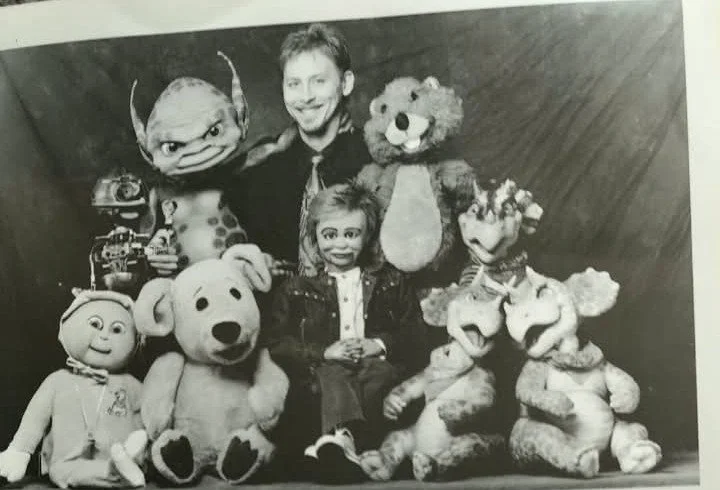
David Strassman and Animatronic Pals. I couldn’t start the article without them, so I thought I’d finish with them.
→ If you want to see what happens when an algorithm starts deciding what you might want, Sometimes we stumble into where we want to be and other times the algorithm gets it right
→ If you want to see what happens when the person making something changes what it means, No, no, no, no, no, no, no, no, no
If the writing resonates, stay with it.