
No, no, no, no, no, no, no, no, no
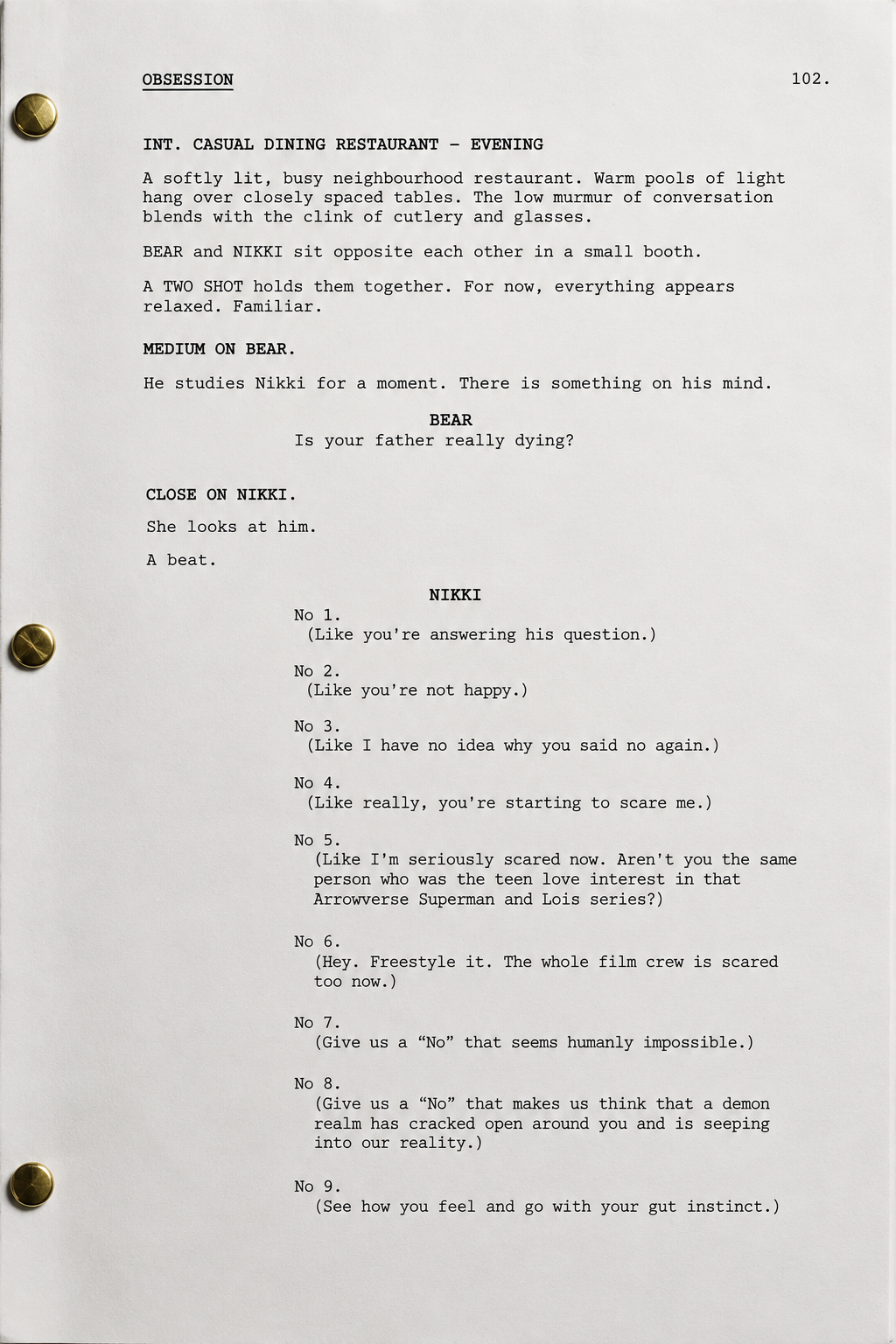
I saw the poster for the film Falling Down and knew I was going to love that film. I did the same with the poster for Fight Club. I don’t know what it is but sometimes you just get a feeling and you know. I got the same feeling from seeing one scene from Obsession. Yes. Of course it’s the No, no, no, no, no, no, no, no, no scene. There was just something about it, something very basic and it’s a staple of many horrors. It’s taking something so normal and distorting it to worrying levels. If it was played just as “girl has some sort of fit and says no nine times in a row,” then it doesn’t work in the same way. But Inde Navarrette plays it like someone glitching, like they are actually breaking, like the moment has caused the vocalisation of words to stall or be caught in a loop. Her expression isn’t exactly saying “no.” In fact she runs through about ten different intense facial expressions in the time it takes to say no nine times. It’s magnificently troubling. I was pretty sure that there was no way that one scene was an anomalous moment in the whole film. Surely enough, Inde Navarrette has many more moments.
It’s almost a blessing when she properly goes off the rails. By the time she’s bashing her friend Sarah’s face in against a steering wheel, she’s a monster we can finally understand. We see monsters in horror all the time. We understand that. Where the film is really disturbing is in the transition, in seeing the things slowly going wrong with Nikki, the things that hint at what’s bubbling underneath.
The switch over to new obsessed Nikki is instantaneous, and the moment Bear wishes that Nikki loves him “more than anyone in the fucking world,” she is seen as a dark silhouette on her porch, backlit by the porchlight, seemingly staring out at Bear as he sits in his car, having just dropped her off. You feel the change instantly. The film had built Nikki’s character up for all of fifteen minutes. We had a sense of who she was as the cool outgoing Nikki. You know she’s changed. You know this film is a “wish-gone-horribly-wrong film.” Of course the wish worked. The question is always – how well did the wish work and how is the result of that wish going to manifest itself?
We know the answer. We keep watching to see how wrong things can get.
The “No No No” moment did remind me a lot of the film Smile in which the distortion of something as normal as a smile becomes terrifying. “No no no” is made all the more impactful with the setting being a restaurant. You feel like another world is seeping into ours when anything like that happens. That’s the stuff of nightmares. For the audience the fear is the anticipation of the monster. The monster is almost always a relief when it arrives. So, eking the monster out of the character of Nikki is what the film does best, and the whole thing then becomes all about performance. It would be interesting to know what film we’d have been watching if it wasn’t Inde Navarrete as Nikki, but I think it’s fair to say that, as good as everyone is around her, she is this unnatural force of dark nature that stirs up everything around her.
And despite this central performance the film finds a lot of time to be doing several things at once. The four main characters have tangled relationships. Sarah likes Bear. Bear is obsessed with Nikki. Bear’s best friend Ian knows all about Bear’s feelings for Nikki. Which is why one revelation in the latter parts of the film is a real punch to the gut. Sarah tells Bear Ian has been on and off sleeping with Nikki. Oh dear. We have a messed-up situation before things even get to the supernatural nightmare. That moment when we find this out gives us an interesting setup. The real world starts showing up in the latter half of the movie and even the real world isn’t what we thought it was.
We have Nikki talking in her sleep, as real Nikki, as though she is trapped inside obsessed Nikki, begging for Bear to kill her. The woman he really loves has no sympathy, no love for Bear and the line, “You’ve never really been with me” is harsh. It cuts deep for the viewer. We get to learn that Ian is the type of asshole who would wish for a billion dollars instead of helping his friend. But the sleeping with Nikki is inexcusable. The real world has its own horrors.
The lovely real-world moment where Bear and Sarah are about to open Sarah’s letter that will confirm she has got her place at University, is violently highjacked by a Nikki who is now unrecognisable. As a piece of storytelling it’s a fantastic collision of the real world and the supernatural destructive force in the film. Sarah’s demise at the hands of Nikki is all the more sad for what could have been if not for the fact that Bear and his own obsession, his love of Nikki, has ruined everything. The cruellest part is that Bear doesn’t even find the time to feel anything about all of this, leaving us, the audience, to feel for him, to be angry at Ian and sad for Sarah and despairing at the idea that maybe Nikki wasn’t everything Bear thought she was.
Every “wish gone wrong story” seems to be a parable to remind us that we do not need wishes. The positive lesson to take away is in knowing that not making the wish is trusting the universe, the natural good in life that we should cling to, not some wish for what we think we want. Bear naturally gets somewhere good in life if he sees what’s really in front of him. If Bear were to see that Nikki and Ian are sleeping with each other behind his back, if he could just realise that Sarah is a far better fit for him than Nikki, he wouldn’t need to make his desperate and ill thought out wish. Wishes always seem to be dished out to the desperate. That’s what Djinns and Genies do. They feed on your desperation, your desire to have what you want, even if it wasn’t what the universe intended for you. If you believe in fate, then that’s why all the wishes go bad. It’s a cheat. You are cheating fate, cheating life, cheating the gods. And you’re going to have to pay for that.
The idea that we are beholden to words to express wants and desires that we don’t even understand is our downfall. It’s how our wishes destroy us. Oedipus receives a prophecy that he will kill his father and marry his mother. To avoid this disaster he moves away, not knowing that the parents he left are not his biological parents. And guess what? Unknowingly, he kills his father and marries his mother. The witches in Macbeth tell Macbeth he’s going to basically be everything he wants to be, Thane twice over and eventually king, only to find out that there’s a catch. None of woman born can harm Macbeth? Macbeth doesn’t question these words. He certainly does not comprehend that Macduff was “from his mother’s womb untimely ripped.” According to supernatural law, it appears that being born by caesarean doesn’t count as being born of a woman. Macduff kills Macbeth.
Any Faustian pact with the devil is always going to have a good chance of going wrong because we’re dealing with things we do not understand. We are asking for something that we do not have words for. What does it mean to love someone more than anyone else in the world? What exactly did Bear ask for? He essentially wanted someone or something to make Nikki love him. What he wished, what he asked for, is something that can’t really have the type of shortcut that a wish can give you. In stories like this, you can’t make someone love you. It doesn’t count if the other person didn’t have free will. You can’t wish love into existence. So, he gets the nearest thing to that. He gets a version of love, a twisted one. He gets a version of Nikki, one fuelled by a love that is forced on her. He has something that looks and sounds like Nikki but, as she has pointed out to him in the sleep-talking scene, it’s not her. Most interestingly, love becomes an action. What Nikki can give Bear is the act of love, without ever loving him.
The Nikki that he encounters is not who he wants. Or more accurately, does not behave like the Nikki he knew and loved. He even says to her that he wants her to behave like herself. But love has become something she shows, something she does. That’s the facsimile of love Bear gets, and what happens is, without the belief of being in love, all that’s left is an act. She behaves like someone in love. Although it’s love to the Nth degree. It’s a twisted idea of love. But then Bear never stipulated exactly what love looks like. It seems that in this case love requires reciprocation. Obsessed Nikki loves Bear more than anything and one result of that state of being is to need to know that Bear loves her as much. Everything she does becomes an act of love and a demand to be loved back. When Bear does not love this version of Nikki, then the roles are reversed. Nikki wants to be loved by Bear and ends up wishing for and getting Bear’s love, which is as real as hers is for him. No No No Nikki is where we cross over the line. It’s where normality melts away. It’s forever going to be an iconic movie moment, and it is one part of an amazing performance. I can save you time and money by telling you that if you have any doubts about the film, just watch that No No No scene. Everything you need to know about the film is in that moment.
Where next?
→ If horror is your thing, or even if it isn't, You don’t like horror? What the hell’s wrong with you?
→ If you want to explore what happens when words fail to contain what we mean, The beauty and power of words Part 3: Writing is its own language
→ If you want to see how a character has to become more than a collection of words on a page, Marvel’s Cosmic Powerhouse Goddess? Who the hell is going to play that on screen?
If the writing resonates, stay with it.