
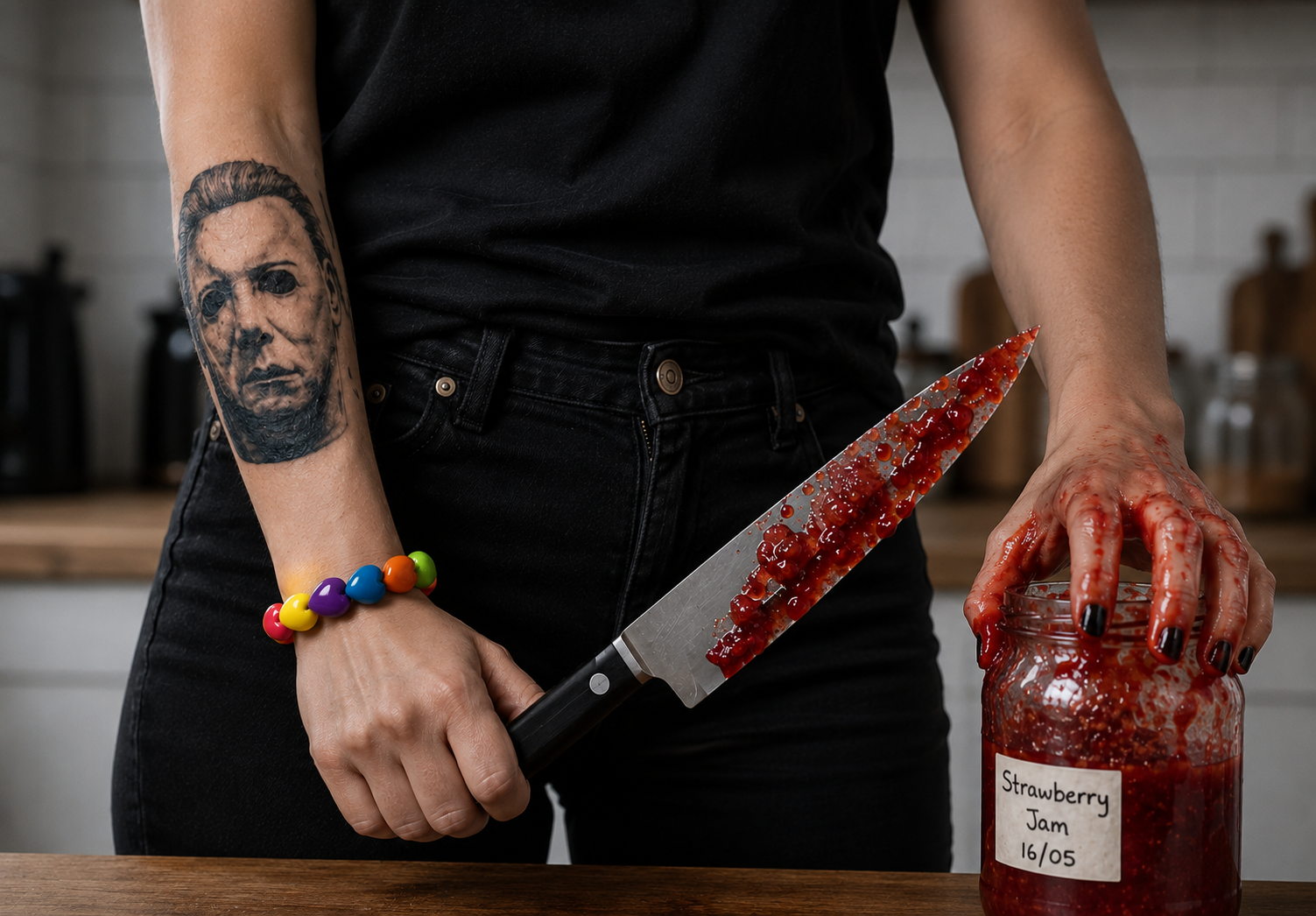
Image concept: Ally Chisholm, Katie, D and Chad.
When I was a child, I was on holiday with my family in France. We were in a small town and had gone into a patisserie to buy pastries. Whilst in there, Mum subtly nodded to a man in the queue. I looked puzzled. I looked at the man, and he looked normal to me. Moments later I saw him from a different angle and one side of his face was nothing but a mass of misshapen flesh. As an adult, I suppose they must have been tumours. As a child I was slightly traumatised. Years later, I asked Mum why she made me see that. She said that she wanted me to be aware of all things in the world.
We all watch The Elephant Man and say, “I’d be nice to John Merrick,” but then in reality we are taken over by reactions that reflect our difficulties accepting what we see as abnormalities. I once attended a very good lecture by Dany Nobus, Professor of Psychoanalytic Psychology at Brunel University, and I took away from that the idea that “Nature loves a freak, but society doesn’t.” Excuse my paraphrasing. This was punctuated with a picture of someone with a deformity next to a picture of the same person after plastic surgery.
Not wanting to watch horror probably makes a lot of sense. And yet I can’t understand a mindset that says, “I can’t stand horror.” What, all horror? Surely The Exorcist is good? The Shining? Pretty good. Psycho? Silence of the lambs? Alien? Maybe there’s people out there who say they do like Silence of the lambs but it’s more of a psychological thriller than a horror. Maybe there are some people who don’t like Alien because it’s both a Sci-Fi and a Horror. When I was young, I remember that a friend of a friend had said that they turned off Star Wars after Obi-Wan cut off that guy’s arm in the Cantina. Is Star Wars a horror? Is Ghostbusters? Once again, labels can deceive. There is no way you’d call Ghostbusters a horror. It’s absolutely a comedy. It’s a Bill Murray film. He owns every moment in that film. Horror is all about atmosphere, more so than gore. I’m thinking about how they could turn Ghostbusters into an actual horror. There’s a rewrite to imagine.
This comes to mind because I was recently watching Black Phone 2. I was enjoying it, but I wasn’t feeling scared or jumpy. I was fascinated by it. In particular, there was the windowpane dream scene, where someone has half their head sliced off by a falling pane of glass. Half of a face lies there on the floor making pitiful noises, and when our protagonist looks up, she sees what’s left of the figure outside, and it too is still living and making horrible screaming noises. Revulsion is the obvious reaction. Fascination is also understandable.
Before we get to fascination though, I’m thinking about all the things that don’t fascinate me. I’ve never been one for torture porn. I don’t get Saw or Hostel or The Terrifier. It seems like extreme torture and violence for the sake of it. And I think that if that is the only image of horror that people have, I can understand not liking it. Maybe there’s an essay there to be written about the joys of revulsion. But I’m not the one to write about it. So, we’re clear, slicing someone’s head from crown to cheek is fine, anything Jigsaw does in Saw just isn’t the same.
I know. What’s the difference? But there is a difference. That one scene, in a horror film that wasn’t particularly special, is a good reminder that there’s plenty of beautiful cinematic horror out there. Body Horror is probably the best example of the beautiful grotesque. It’s all about the human body distorted and twisted. You see it in Hellraiser a lot. It gets a bit S&M-y with the ideas of people chasing the pleasures of pain. You see it in The Thing where the onscreen horror is the twisted flesh that the parasites turn us into. If you really want to gross yourself out, do some research into “Body Suspension.” That’s the one where you pierce your skin with hooks and then get hoisted by the hooks and you hang from them, somewhat like a chandelier made of flesh.
Chandelier made of flesh? It’s funny that my brain went there, that I took something ornamental and made it grotesque. That’s what some of this beautiful horror does. Actually, watching the windowpane scene in Black Phone 2 gave me the same sort of feeling I get when I’ve seen Russian Neo-Cubist art. It can be horrible and captivating.
I’m probably not selling this to you very well.
I understand it when people say that they don’t like being scared. What am I saying? I don’t understand it at all. I get the “not liking being scared.” But all film is simulated emotion. In horror films you choose to watch safely. "I don't like being scared by films" implies a connection to films that I don’t think rings true, because I don’t think I’ve ever heard someone say that they don’t do romance films because they don’t like being romantic. I’ve never heard anyone say that they can’t watch Tom Cruise jump from a building without feeling the same adrenaline rush. If you could feel it that much then it would be amazing. Simply put – You don’t.
There’s a difference between being scared and feeling scared. Horror films, although you do often need to deal with the revulsion factor, are less scary than amusement park rides, which can give you something to legitimately be scared of. My greatest fear on any amusement ride is the very real prospect of it breaking down and leaving me hanging upside down for three hours. Sure, it’s not as gross as watching the scene in Evil Dead 2 where Ash chainsaws his girlfriend’s head from top to bottom, but I’d take that watching experience over the kind of trauma that you get from being stuck on a rollercoaster. In either case, what we’re really talking about is discomfort.
So, why choose discomfort? I think back to my childhood and the Frenchman in the patisserie. That was not a choice I made. I did not choose to look. Mum thought I should see the world and all that’s in it. Horror is basically about the tension between choosing not to look and knowing that sometimes you should. The counter to anyone asking, “How could you possibly like watching horror films?” may possibly be “Why wouldn’t you ever choose to look when it’s safe to do so?”
It becomes about curiosity vs avoidance. Why is simulated fear rejected while simulated excitement, sadness, or joy is accepted?
That’s not to say that I am curious about all horror. I’ve already stated that I don’t like “torture porn,” and my curiosity dies there. There’s a particular type of splatter horror that doesn’t do it for me too. From the description alone of Peter Jackson’s 1987 film Bad Taste, I’ve steered clear of it all my life. Re-Animator too. I’ve avoided it all my life. The kind of gross out that I’m not drawn to is where people become soggy wet bags of flesh. I don’t know why. But I’m not putting all horror in the same bracket.
By no means is this a masterclass in subgenres of horror. It’s just a smorgasbord to dine from. Accepted at my table is Doctor Hannibal Lecter, who has ordered the brains served fresh from the living heads of FBI agents. All of Leatherface’s family from the Texas Chainsaw Massacre. Yep. Bring ‘em in and seat them down in the chairs made of human bones that I just got delivered. Someone tell Jeffrey Dahmer to get his human body parts out of my fridge and get them here to our smorgasbord.
No. Not a masterclass. But I am keen to think about what you can be drawn to in horror. By chance, the three examples above are examples of “what happens when the brain and society go wrong.” All three are serial-killer-driven. Dahmer, obviously a real-life serial killer. Lecter, a work of fiction but author Thomas Harris drew on real life serial killers when creating his character. Shout out for Ted Bundy and Ed Kemper there. And the granddaddy of all serial killers, Ed Gein, was very much an inspiration for Tobe Hooper’s Texas Chainsaw Massacre. It’s hard to watch that type of film and not be fascinated by how humans can go so wrong and how societies can produce such individuals.
I don’t know what this counts as. Is it curiosity about ourselves, about humans? Is it a desire to know that these things exist, as a survival instinct? It’s no different to cavemen hearing stories about other cavepeople being torn to shreds by a sabretooth tiger. Did they huddle around a fire in their caves showing cave paintings of sabretooth attacks and some of the tribe said, “I don’t get why you like these stories. Can’t we have a nice cave painting story about how Mum and Dad met?”
All I’m saying is that, to me, there seems to be something innate in us that is curious about the most horrible things in life. So, an attitude of, “How can you watch horror films?” seems to deny something in human nature. Despite my ironic tongue-in-cheek title to this article, that’s not the same as saying, “You must like all horror films or you’re plain wrong.” It’s more a case of, “Well, surely you can see why I’m a little bit curious.” Perhaps there lies the divide. “How can I watch that?” vs “How can you look away?”
If it’s entirely about preference, then that’s one thing. I don’t go for Kabuki Theatre or Bollywood films. I tend not to go anywhere near any animated films where inanimate objects start singing. I’m willing to hear what I’m missing out on though. I get the revulsion to the whole genre. I mean really, a singing candle? Singing cats? It’s all horrific. The Siamese Cat Song in Lady and the Tramp is truly disturbing.
OK. I couldn’t resist that.
If stories are one of the safest ways we have to confront the uncomfortable, what does it mean to avoid that entirely? Does avoiding that mean that it is no longer a preference but is in fact a choice to look away? I think, in real life, there is a desire to look. People rubbernecking when there’s a car crash is a classic example. Mum pointing out the man in the French patisserie, making the choice for me is another. We don’t want to see these things but part of us does. It’s just that when you’re watching horror you are making a definite choice to watch. There’s no “Should I look? Shouldn’t I?” otherwise, what’s the point?
Also, I wouldn’t suggest that all horror is profound. Some are plain dumb fun. All of the Scream films are. The first ten minutes of the original was intense but then after that it felt a lot like a very long MTV music video to me. Equally, most of the Nightmare on Elm Street films are very silly. The first one is good. But after that it became a litany of imaginative deaths and all you could ever do was want more and more silly deaths. Sometimes you can play a good game of trying to predict the order that the annoying teens are going to die in. There’s something about that sort of film where you’re actually rooting for the monster. You want the horror. That’s the thing. And when you get the horror, not always in the way you expect, then you're happy for the horror, for the genre doing what you want it to do. There’s a whole essay in why that’s fun to watch.
If you come across an article that provides a concrete argument for simply liking watching people suffer, if you find an article called “What do you mean you don’t like watching people getting hacked to pieces? What the hell is wrong with you?” I’d like to read it. However, you’d have to ignore a lot of what’s going on in the genre to come up with that take on horror.
I’m willing to be convinced that my view on this is narrow, but mostly, horror is built around a desire for the unknowable, this other place, which we cannot make sense of, but equally can’t leave alone. H.P. Lovecraft tapped into that idea, the idea that there is a world beneath this one, an ancient world so unlike ours, indifferent to us and yet wilfully cruel. Lovecraft’s worlds always leave me feeling that there is a force out there that can rip us to pieces, the way people could rip the arms and legs off an insect or squash a bug.
In many cases, we only ever glimpse these other places. Audiences know that they will never understand. Aware that hints and suggestions are the closest we get to any big reveal, we still look and are worse for never quite seeing. All we know is that there’s something horrible out there and that’s all we can ever know. In Paul W. S. Anderson’s Event Horizon, you have a classic ghost ship story. A salvage crew is sent to check out the Event Horizon as it returns to our galaxy, having been lost in a different dimension for some years. It returns with no crew and an evil presence onboard that slowly turns the salvage crew murderously insane. The ship itself seems alive and malevolent and intent on taking everyone back to hell with it.
The merging of a tangible, physical hell that can actually be travelled to with something completely unknowable is what makes Event Horizon so unsettling. All we know is that whatever the Event Horizon has brought back with it, it manifests itself as a living hell, whether it is haunting your mind or ripping your body apart.
Then again, sometimes you can clearly see the horror and that doesn’t help you understand what you’re seeing either. In John Carpenter’s The Thing you get to see the distorted mass of flesh that the parasite turns its hosts into, and that’s made all the more horrific because it takes recognisable animals and then later people and stretches skin and muscle and sinew into abominations. It was Stephen King, in his book Danse Macabre, who said that death is not what horror is about. Horror is when the monster gets you. It is a fate worse than death to be absorbed into The Thing and exist as a tortured conscious lump of flesh, intent on devouring everything in its path. A lack of explanation only adds to the horror. We can see these “Things,” but we still can’t understand them, comprehend them, know them, or know how to kill them. We’re left staring at them, hopefully happily sickened and horrified and somewhat fascinated at the same time, and curious, but never wanting that curiosity to be sated. We want to look, but we know we can’t do so for too long.
Supernatural malevolent presences from a hell that has invaded our world and alien entities invading our own flesh are two very different unknowable horrors. But you can scale it back, have no supernatural or otherworldly element, and still feel that the horror you’re watching is equally as distorted, as wrong, unnatural and unsettling. If you look at Hooper’s Chainsaw Massacre, you can see how we, the audience, stumble into an unknowable world of “almost human” beings, who we cannot comprehend. Leatherface’s family do not live like us. Human life does not have the same value. Humans can be culled like pigs and hung on butcher’s hooks to bleed to death. The dinner table scene is all the more twisted for taking something as normal as dinner and making it a grotesque nightmare. The most disturbing scene in the whole film and nobody dies.
There has to be something more than suffering and death to make horror work. Stories are a desire for something more. Horror stories are a desire for something more, that maybe you shouldn’t want. But the very idea that you do, that you want it, that you can’t look away, only makes you want to see it more.
When I hear, “I do not understand why anyone would watch horror,” my immediate thought is “I can’t imagine a world without the urge to look.” I ponder the idea of having no curiosity towards things greater and darker than ourselves. How do you do that? Cheap scares, gore and shock are part of horror but there’s plenty of bad horror where even the shocks aren’t so shocking if that’s all you’ve got. That can be unwatchable and even horror fans would tell you that. I think, rather than knowing and understanding, horror gives you the comfort of not knowing, of being confused, of having no answers, but being left with a feeling that there are things greater and more horrific in existence. It is about feelings. It is about giving in and not only looking but feeling something, something intense, something that you can feel long after the end of the film.
Horror stories are usually wrapped in metaphor and dressed as cautionary tales, and, when done right, can tell stories and examine humanity in a way that no other type of story can. Horror tends to be full of big ideas. Then again, sometimes it’s this:
In Wes Craven’s original A Nightmare on Elm Street, a young Johnny Depp is slouched in bed trying to stay awake, knowing that if he falls asleep Freddy Krueger will kill him in his dreams. He’s on the bed watching TV and listening to loud music on his headphones. His Mum asks him how he can listen to his music and watch the TV at the same time. He responds with, “I wasn’t listening to the tube. I was just watching. Miss Nude America’s going to be on tonight.” She replies with, “How can you hear what she’s going to say?” Of course he says, “Who cares what she says?” In the next scene we see he’s fallen asleep and he is sucked into the bed like someone falling into a sinkhole and seconds pass before a giant geyser of blood erupts and covers the room. By the time the paramedics arrive, a police officer is heard telling them, "You won't need a stretcher up there. You need a mop."
Four decades later I’m still not sure that’s saying anything profound. But still an iconic horror moment.
Where Next?
→ If you want to explore how labels can stop us experiencing what’s actually there, The Margaret Atwood Appreciation Society
→ If you want to explore why not understanding something doesn’t mean you can’t experience it, Understanding not necessary
→ If you want to explore why sometimes we don’t just want to look into another world, we want to walk around in it, Walk around in this world if only for a while
If the writing resonates, stay with it.