
Welcome to Nineteenth century Russia please walk around, even if it does all seem baffling
Concept by Ally Chisholm. Design by Chad
I am not an expert on Russian literature. Ignore for now that I have been to Dostoevsky’s house in St Petersburg. That’s something that just happened. I have been to Russia twice on work trips. It would have been silly not to go. I meant to do it, as opposed to when I was in Moscow and accidentally went to see Lenin perfectly preserved in his tomb at Red Square. I thought I was queueing for the Kremlin. It became clear that it wasn’t the right queue. I did realise before I entered the building that I’d been queuing for Lenin’s tomb, and I was about to meet his embalmed body. For the record, accidentally waiting in line to see Lenin still does not make me an expert on all things Russian.
I don’t think that reading a dozen Russian novels makes me an expert. I’d say that doesn’t change if I throw in some graphic novel Russian lit. Bulgakov’s The Master and Margarita and Dostoevsky’s Crime and Punishment look great in comic book form. Giving your website the tagline of, “You can’t write like Dostoevsky if you only use emojis” does not make you an expert. Seeing Chekhov’s play The Seagull at least three times? Nope. That doesn’t even qualify. I did read a complete history of Russia from start to finish. It was background for the novel I was writing. It’s a good read and I thought that if I was going to write about a character who studied Russian history at university then I better know a bit about it myself. I still don’t think that makes me an expert. For Christ’s sake, I’ve never even read any Pushkin and that’s supposed to be a true measure of how “Russian lit” you are. Note to self: Buy Eugene Onegin. Second note to self: Work out which pronunciation of Eugene Onegin is actually the correct pronunciation. I’m not an expert and I don’t think I need to be. I know enough to have a discussion and that’s all I need.
At Middlesex University a long time ago, I studied a module called, “Modern European Dramatists.” I think I was expecting “cool and modern and edgy.” It turned out that the university’s idea of modern was different to mine. We studied Chekhov, Ibsen, Strindberg and Brecht. Turns out, not so modern to my young eyes, but still “cool and edgy as fuck.”
This was the one quote that got me hooked:
Just consider this. A man spends precisely twenty-five years reading and writing about Art when he understands precisely nothing about it. For twenty-five years he chews over other men’s thoughts about realism and naturalism and every other kind of rubbish. For twenty-five years he reads and writes about things that clever people have known for years already, and that stupid people don’t care about anyway. For twenty-five years, in other words, he’s been shovelling a lot of nothing from here to nowhere. And yet what an opinion he has of himself! What pretensions! He’s reached retiring age, and not a soul has ever heard of him. He’s completely unknown. So, for twenty-five years he’s been usurping another’s rightful place. Yet lo and behold - he paces the earth like a demi-god!
Anton Chekhov - Uncle Vanya.
And that is the best translation I know of it. I don’t know if it’s the most accurate, but I want it to be. The fact that I wanted to storm the stage during the version I saw at the Almeida Theatre in Angel Islington, when they changed the line to, “And he walks around like he’s Jesus Fucking Christ,” does not make me a Chekhov aficionado.
There was something in particular about “Yet lo and behold - he paces the earth like a demi-god!” that was special. Although “he walks around like he’s Jesus Fucking Christ” does get the tone of it, it does lose a lot of what the “demi-god” version offers, which is as mocking as “Jesus Fucking Christ,” but a truer reflection of the character in question. It’s the voice of the writer and the ideology in that moment. The “lo and behold” does a lot of the mocking. The “demi-god” on the other hand, always gave me some sense of something so specific and a true idea of what is being mocked. The idea of being smart, of being a professor, of being an educated intellectual, that’s the demi-god that both Uncle Vanya and Chekhov are looking at.
Hang on. Are we supposed to understand that as Uncle Vanya says those words, that literature is its own sort of God?
And as I write that, it makes me feel like I’m now pacing around within this article, like some sort of divine quasi-faux God of word usage, ripe for ridicule.
I wonder how that translates into Russian. I’d say that there’s something clever going on there, or possibly I’m deluded. Who cares? It doesn’t make me smart for thinking that. You’d be thinking that too if it had been kicking around in your head for decades.
Despite Chekhov’s idea of literary demi-gods kicking around in my head for years, of those modern European dramatists, I think I liked Ibsen more, and he’s Norwegian. Russian literature could wait. And keep waiting. The big hitters, the ones that you think are only for hardcore intellectual readers, were there as a challenge, and maybe one day I’d get around to them. War and Peace can definitely wait.
I understand the challenge of reading a novel simply because it’s a challenging read. It’s the main reason I read Moby Dick. That, and the whole Star Trek Wrath of Khan and Ricardo Montalban spitting his spite at Captain Kirk with the words, “To the last, I grapple with thee; From Hell's heart, I stab at thee; For hate's sake, I spit my last breath at thee.” God damn! I can’t hear or read the word “thee” and not think of my friend who recently said that he doesn’t like Shakespeare because of all the “thee and thou” in it. Now I have to tell him to knock off both Marvel’s Thor and Star Trek 2 the Wrath of Khan from the list of films I’d recommended.
Classic Russian literature has a reputation of being a challenging read. I think that’s a very sweeping generalisation based on the average reaction to novels that can easily be used as doorstops. Notes from the Underground is not that. That’s a sort of gateway in to Dostoevsky because it’s got a lot in common with the type of novels that speaks to a certain young disillusioned and rebellious mind. It’s where you discover that there’s something rock and roll about Dostoevsky. You find that spirit running through Bulgakov too. Heart of a Dog is satirical and surreal and anti-establishment.
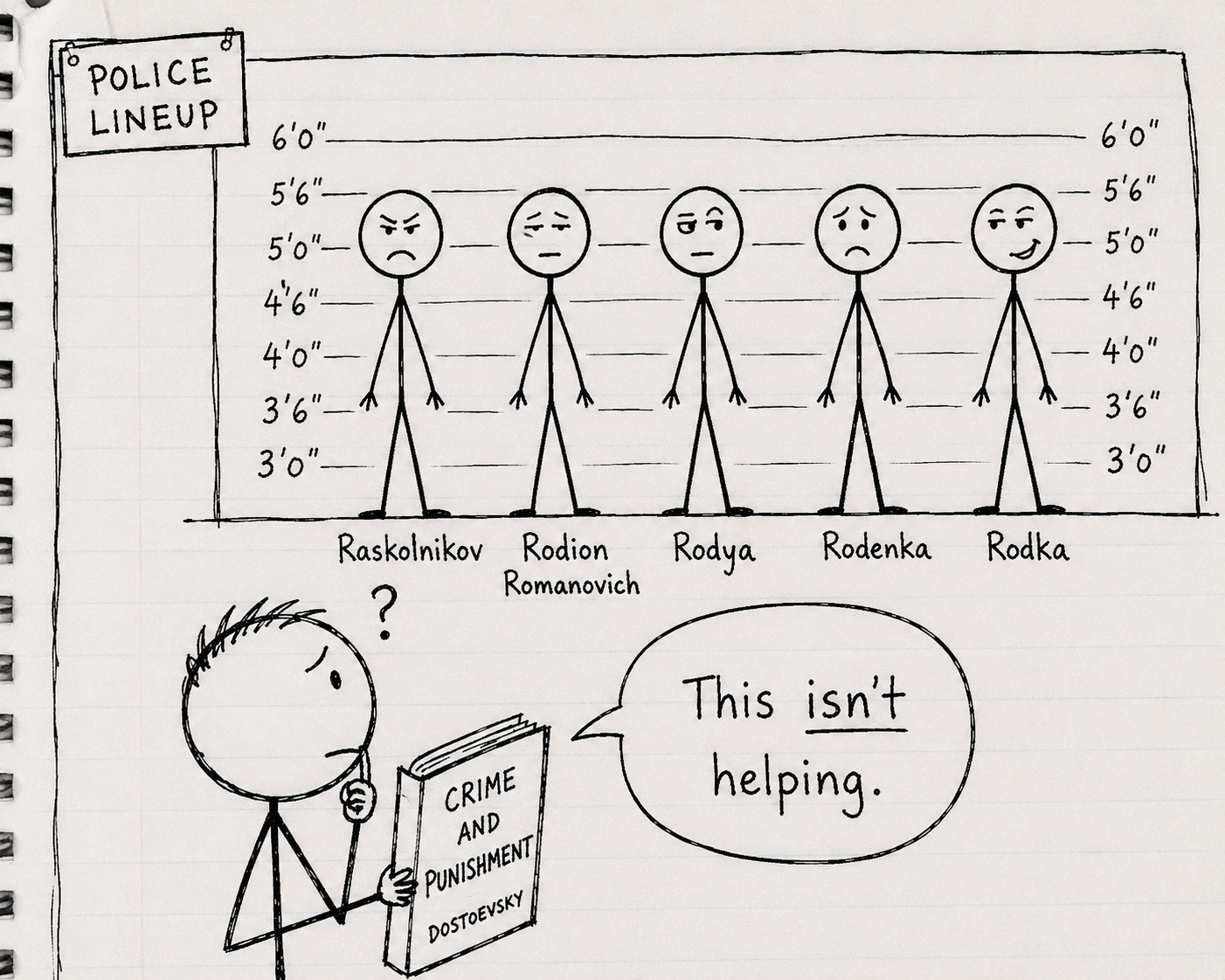
Also, as you can clearly see, you read just enough Russian authors and you start using the author’s surnames, instead of their full name, like you’re best mates. Names are actually a big deal when it comes to Russian works. Firstly, you have to try really hard to get your head around the whole patronymic naming system, and that no one ever seems to be called the same name twice on any page. It’s very possible that you could be reading Crime and Punishment, knowing that the protagonist is known as Raskolnikov, that his full name is Rodion Romanovich Raskolnikov, and yet still read passages where he is referred to as Rodya, Rodenka, and Rodka, and you’re asking yourself, “Who the hell are these people?” Rodion Romanovich? Who’s he? Oh, he’s Raskolnikov? Romanovich is just his patronymic name that is sometimes used but sometimes isn’t. I do feel like I’m in a room of Russians trying to work out who’s referring to whom? You think everyone else knows who they're talking about but maybe they don’t.
There is no exam at the end of any of these novels. I’ve not read it, but there’s a short story called "The Nose" by Nikolai Gogol, in which the protagonist’s nose decides to one day leave his face and start a life of its own. What would the exam at the end of that look like? Another note to self: Must read Gogol and then make legitimate claims of Russian literature not all being heavy melancholy challenging reads.
The best advice about any art is that sometimes you just need to go with it and don’t worry about how much you understand. Life is a conversation in a noisy pub. You're not supposed to hear every word. Just go with it. It’s a world to walk around in. We've become conditioned to think that art is a test. We ask, "Did I get it?" We’re made to feel stupid for not “getting it.” There’s a lot to be said for “getting it,” but that does not need to be everyone’s starting point. And it can’t be.
We don’t expect it to be the case in anything else we enjoy. We don’t look for it in music. We don’t need to know every lyric. Grunge was more fun that way. We didn’t need to know exactly what Smells Like Teen Spirit was about; it tapped into something we all recognised and clung to. God bless Kings of Leon who, a decade later, released a first album full of songs where no one had a clue what anyone was singing about. I have this theory that the band actually got worse the more I could understand what they were singing.
Shakespeare? I have a theory you could watch it with no understanding of what’s being said and still feel what’s going on. A novel like Thomas Pynchon’s Gravity’s Rainbow or David Foster Wallace’s Infinite Jest is built on a bed of complexity, and intentionally so. I was once told that James Joyce’s Ulysses won’t make sense until about the fourth read through. You have to really really want to understand it by the time you’re on your third, I’d say. And then you think, “Nah. Better go back to the start and try again.” Yet another note to self: You own Ulysses. Go read it sometime.
I’d offer up the idea that if the challenging reads made sense, then you’d be disappointed. You’ve come to this place to see the complex architecture. Why do you think you’d understand it all instantly. Confusion is a landscape. Take it in. Understanding is not a prerequisite for enjoyment. I’d also point out that much of Russian literature is bonkers. Bonkers in the same way that modern cool fiction is. That would be my number one selling point, not that it’s challenging or that War and Peace has two-hundred-and-thirty pages describing one battle scene.
Russia, mythical Russia, literary Russia, seems wrapped up in the wretchedness of life, forever facing inner turmoil, always seeming lost. I’m surprised more teenagers aren’t wearing Russian lit like a fashion item. As you’re standing there, despondent in a noisy pub, you squint and think of a world where Russian literature is somewhere you’d like to visit, even if you don’t speak the language. And if anyone asks about your credentials to be wearing a Dostoevsky T-shirt…, well, you can only laugh.
Where Next?
If you'd like to continue the conversation, this is where I'd suggest going next.
Understanding Not Necessary
You don't have to understand everything to have a worthwhile experience. In fact, trying too hard to understand can sometimes get in the way.