
How to Play Quarterback Drunk
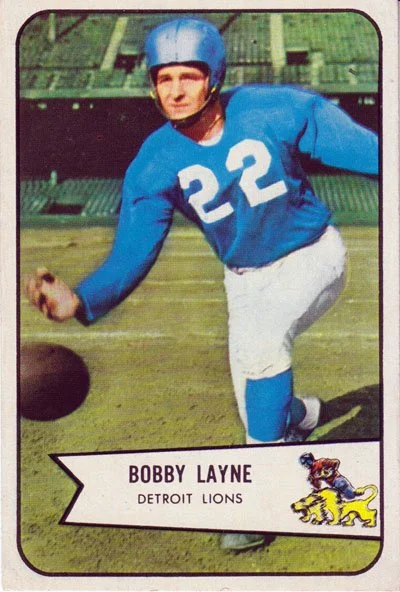
Photo: Bowman Gum, Public domain, via Wikimedia Commons
Bobby Layne’s legend is ridiculous. He was a Detroit Lions superstar in the 1950s. He lived a wild lifestyle of boozy all-nighters. He played games with hangovers, having had only two hours of sleep the night before and legend has it, he’d even drink during the game. A couple of whiskies at halftime only seemed to make him even better. He is widely known as the man that invented the two-minute offence. Imagine being in a game, calling your own game, with only minutes left in the fourth quarter and you’re hungover and need six points to win. That’s Bobby Layne territory.
Putting this in some sort of perspective, I remember the last time I tried any sports whilst boozed up. I don’t booze anymore. I gave up for the good of my health. The last time I did have a drink, and it was a drink too many, was at one of the NFL games at Wembley in 2018.
We don’t really do tailgating like they do in the States. Over here it’s just a lot of people hanging around drinking before the game. Hey. Maybe that is tailgating! It just feels different to what I’ve seen in the US. With all these people milling about before the game, some of them are throwing a ball around. It was after six pints that I was feeling cocky enough to say to a couple of young guys, “Hey. Give me the ball.” Maybe just to get rid of me they pitched it my way. I gripped the ball and hurled the most ugly-looking pass that short hopped its way to my intended receiver. People laughed. I was actually pissed, in the American sense of the word and the British understanding of it too. But genuinely, I’ve been throwing a ball around for decades more than these youngsters and I couldn’t leave that last throw out there as the truth about how I throw the ball. So, I said, “Come on. Give me another.” But they didn’t. They passed it back and forth and were not going to give me the ball. So, the next time they threw it, I zipped in front of the pass and, stealing the ball from the receiver’s hands, just before he could bring it in, I made a beautiful pick. Nothing but hands. Smooth. Clean. I then said, “Go deep.” The other guy did and I probably overthrew him by about a good five yards. It wasn’t the perfect spiral that I’m capable of, but it had some distance. I proved I could throw. People again laughed. I walked away and said to a couple of laughing strangers, as one patted me on the back, “That isn’t easy after six pints.” I now wish I’d said, “Jeez. How the fuck did Bobby Layne manage this?” I went back to the sidelines. Chucky had another beer waiting for me.
By modern-day standards you’d say that a professional sportsman having a couple of whiskies in the middle of a game of football, would be problematic. The thing is, Bobby Layne would do this, and his game would not suffer for it at all. So, we don’t think too hard about the “problem.” Detroit keeps winning and Bobby Layne keeps on drinking. We’re good.
One of the most famous Bobby Layne stories has him beating a drink driving charge by explaining that he had not been slurring but rather his Texas drawl had been mistaken for drunken slurring. The judge agreed. No charges were brought against Layne. There’s no question of bringing the game into disrepute – not back then.
Layne played for fifteen years and he was one of the best. Statistically he racked up the numbers and set records. But mostly he won games. He won championships. Much was made of how he didn’t throw the prettiest spirals. That didn’t matter to him. He once said, “You could throw it end over end as long as you score a touchdown.”
Hardcore drinking aside, if you just watch highlights of Bobby Layne, he made great plays. Watching him scramble and run for touchdowns made me think of that Lamar Jackson, Jayden Daniels, Caleb Williams sandlot-backyard football style of play, that we think of as the modern game. It’s not meant as a direct comparison. I’m just thinking of players who play free and easy.
Watching Layne now reminds me how much quarterbacking changed. By the time I started watching in the 1980s, the ideal quarterback was still expected to stand in the pocket and beat you with his arm. Randall Cunningham was forever being told to stay in the pocket. Dan Marino, Warren Moon and Dan Fouts became the standard by which passing was judged. Even Joe Montana, who could move brilliantly, was admired more for what he did from the pocket than for what he could do outside it.
That’s not what you see in Bobby Layne. It’s little wonder that he excelled when the game was on the line. He just found a way to score. The best quote ever regarding Layne comes from his teammate and good friend Doak Walker “Bobby never lost a game; sometimes time just ran out on him.”
I see the 1968 season as the tipping point, the moment the AFL arrived, that Joe Namath arrived, the merger was culturally ratified, and the New York Jets beat the Baltimore Colts in the upset that shaped the football that was to follow. I often feel that anyone playing before then, before the 1960s, before the big TV deals, before the modern era, existed in a time of myth and legend.
Layne stands at the gateway to modern football. After Layne, Johnny Unitas was the next big thing. And by the late 50s and by the 60s he’d be regarded as the best. Unitas was the model for the pocket passers that followed. My introduction to him was reading about Super Bowl III where he comes on to replace Earl Morral and Jets fans held their collective breath. Although the first drive looked like he had nothing left, the next drive he seems to go through a time warp and play like 1958 Johnny U. He had an aura. Everything was going to be alright with Johnny U in the huddle. Although this time it wasn’t. This time was Namath’s, the game he guaranteed. Football moved on.
Until Joe Montana came along in the 80s, Unitas was the man. The lineage seems set in people’s minds. It makes the 50s stars, like Cleveland’s Otto Graham and Bobby Layne seem mythical, closer to pioneers of the game than to the modern TV era sports stars. Bobby Layne is not so far removed from Red Grange, Jim Thorpe and Johnny “Blood” McNally, the earliest big names in the game.
McNally’s stories make him sound like something Mark Twain would have cooked up. He gave himself the name Johnny Blood, reinventing himself for a football life. He and his friend Ralph Hanson wanted to play semipro football under assumed names so McNally wouldn't lose his remaining college eligibility. Riding to the try-out on McNally's motorcycle, they passed a cinema showing Rudolph Valentino's Blood and Sand. McNally shouted back: "That's it! I'll be Blood and you be Sand." Sand never made it big. Blood did.
Johnny Blood drifted between football, baseball and other jobs. He embodied the idea of the travelling athlete. Before he’d got to Green Bay, he’d earned his status as the “Vagabond Halfback.” The team names even conjure up a landscape of a football map that no longer exists. Milwaukee Badgers. Duluth Eskimos. Pottsville Maroons. I think of how the Portsmouth Spartans, later to be the Detroit Lions, fit in with that parade of names. McNally had a reputation for disappearing and turning up late. He didn’t fit into a professional world. And he seemed to play forever. Back then players rarely played into their forties.
Bobby Layne fits in with all that more than he does with Unitas and those that followed. Joe Namath may have been the last hurrah for that lineage of player. After that, the game got bigger than any of the individuals who built it.
It’s little surprise that Layne is remembered mostly for his wild lifestyle and for the curse of Bobby Layne. Such things make up a myth. The curse itself feels like it belongs more to myth and media than it does to Bobby Layne. Sure, he would have been disgruntled at being traded. Sure, on the way out, he said that the Lions wouldn’t win for another fifty years. It’s not like he said, “I curse you Detroit. I curse you with my powers of drunken witchcraft.” The idea really got picked up in the early 2000s. The myth of Layne’s curse took a life of its own, some forty-four years after he was traded and fifteen years after the man had died. The disastrous Matt Millen years began in 2001. So, I totally understand any sense that something supernatural was in effect.
What is it about the legend of Bobby Layne that has endured? I think in some respect the league wouldn’t want to glorify his antics. There should be a streaming show called “Bobby Layne’s best comeback wins of all time when his blood alcohol level is above 0.20% at kick-off.” If that show exists I need to see it. The problem is that it would just look like a guy playing and winning a football game. There’s no staggering around or getting in the wrong huddle.
Most of what you find online is about the curse and the drinking, but also about how good he was despite his all-night sessions. After one loss, where Layne hadn’t had a late night for once, he blamed the loss on, “Getting too much sleep.” We want to hark back to a time when such an individual could exist. We reach back to a history that we still feel in touch with. It was a different time, but it wasn’t the dark ages. It was the iteration of the game that came before. It was a time when only half the homes in America had a TV to watch the game. There weren’t enough eyewitnesses to corroborate the stories. Only a few people could get close enough to smell the whiskey on Bobby’s breath.
Most people will arrive at Bobby Layne the same way I did: They start with the curse. Then the drinking. His contemporaries called him the best. Three championships in the 1950s backed that up. The one thing I’ve come to grasp is that those three things need to be viewed separately. The curse is its own thing, given all its authority by those who like to tell a good story. The drinking is real. How much is blown out of all proportion? Who knows? The one aspect that is real is the wins, the football, the stats, the records, the championships. (All three of them). Everything else is…, well, it’s just stuff to write about all these years later.
Where Next?
→ If you're interested in how stories become bigger than the people they're about, Anyone Else Spoken to Bobby Layne Lately?
→ If you're interested in why the moments we remember aren't always the moments that mattered, Not Gary Clark
→ If you're interested in how ordinary people become myths that outlive them, A God Raised on a Farm in Kansas
If the writing resonates, stay with it.