
Marvel’s Cosmic Powerhouse Goddess? Who the hell is going to play that on screen?
You’d think telekinesis is a really cool power to have if you were in a Mutant Superhero team. The boys in your team can fight and fly and one of them can shoot laser beams from his eyes and another can blast you with ice. That’s all good for the boys in the 1960s. They like the rough and tumble. As the only woman on the team Jean Grey can move things with her mind. That might be useful.
The boys get codenames like Cyclops, Beast, Wolverine, Iceman and Angel. Angel lets the side down slightly. But Jean? We’ll call you Marvel girl. Don’t complain, later you just get called Jean Grey, before a guy called Chris will turn the universe on its head and change all this.
Sensibly naming comic book heroes isn’t something that seems to exist in comic books. Doctor Otto Octavius becoming Doctor Octopus? What’s the chance of that? The Fantastic Four come back to Earth with extraordinary powers. The naming goes like this. Johnny? You can turn yourself into a living flame. Flame on Johnny. We will call you the Human Torch. Sue, my wife to be, you can turn invisible. We shall call you The Invisible Girl. What? You can make force fields too? And you’re a grown woman? We’re not calling you the Invisible Force Field Making Woman. Not going to happen. So, Ben? You and me left. You seem to be made of rock now. So, naturally, we’re going to call you, “The Thing.” What’s not to like? No. Rocko and Stone-head are childish names. You’re The Thing. And as for me? I’m the leader of our team and my power is stretching really very far. I shall be known as Mr Fantastic! And in the name of alliteration, we shall be known as The Fantastic Four.
Sorry. I couldn’t resist. It does remind me that comics began life as children’s stories. You weren’t supposed to question these things. The silly names, the girl on the team being the physically weakest and the prettiest and someone for the boys to romantically pursue. By today’s standards that all seems wrong. I think the thing that fascinates me is what it all says about our heroes and what we aspire to. That’s the important interaction between reader and (comic) book. Young readers in particular should benefit from seeing people in roles that eighty years ago you just didn’t see. 1963 and it’s perfectly understandable that it’s a novelty to have a girl on the team. Fighting was a man’s thing. Women didn’t fight.
The 1990s started to impact that dynamic. Women could punch too. But Marvel, and Chris Claremont is mostly associated with this, were ahead of the curve, as early as the 1970s. Jean Grey becomes the cosmic entity Phoenix in 1976. By 1980 she had gone from the girl on the team to cosmic powered entity to a source of unlimited power that became too dangerous for a comic universe to contain.
I think that one of things that draws me to what some might call “strong female characters” is that the message I saw was that just hitting things wasn’t enough. Brute force only goes so far. Even The Hulk isn’t only about physical force. Without Banner you don’t really have a story. It seemed to be that different stories were being told from a different perspective and lead characters were strong in ways that were much more relatable, whether they were embodied by cosmic entities, FBI agents or an adventuring young woman with big guns in each hand. Lara Croft could be described as a female Indiana Jones, but they made her tougher than Indy and bigger in every way. She was not a case of making the lead a woman who acts like a man. She could do all the things a man could do but there was no stripping back of femininity. We have to face it though, both Indy and Lara, if real, would be made of gnarly scar tissue.
It was never a case of bringing woman up to the standard of old school male heroes. It felt more about making heroes and their stories more complex. It would be an oversimplification to say that a softer more feminine approach was needed. The 90s was a good starting point for this. Jodie Foster’s Clarice Starling in The Silence of the Lambs, certainly isn’t treated like one of the guys. Agent Dana Scully seemed like a direct descendant. The X-Files Mulder and Scully particularly live in a world I can get behind. Mulder’s strength is his conviction and humour and being true to himself. Twin Peaks has Agent Dale Cooper as the new type of hero, not built on brawn but built on brains. For a story telling world, it made things much more interesting. Life is not filled with problems you can simply punch.
To go with her telekinesis, they gave Jean her telepathic powers. Mind powers were the big thing. Xavier and Jean, the two most powerful telepaths on the planet, were front and centre in the Marvel Universe. That changes the stories that can be told. Now we don’t care about the superhero foiling the bank robbery. That would be like hitting a nail with a wrecking ball. We’re in Superman territory now. It’s not about what your hero can do, it's what they choose to do. Marvel has been very good in grounding their characters in a very real world. DC placed Superman in a position where he learned right and wrong from a young age, growing up as one of us and that allows for a very different moral starting point than is the case for our Marvel mutants. They experience life and then later find out that they can do extraordinary things to impact the world around them. Their morality seems more chosen than the likes of the DC trinity of Superman, Wonder Woman and Batman.
It is not might that is right in these comic book stories. The heroes can easily be villains by imposing their will on people. Charles Xavier could take over your mind. Why even bother winning the argument, when you can force people to see things your way? I think that makes you Doctor Doom. The good guys choose not to be Victor Von Doom. The X-Men are sworn to protect a world that hates and fears them. That’s hero stuff.
The most important thing about Jean is that as soon as the Phoenix force ramps her abilities up to the highest levels, she goes from the girl on the team to the character with the most terrifying powers. She can manipulate matter and energy on a scary scale. I don’t think I’ve ever seen the “girl” in Marvel Girl. There’s always been something feminine, composed and adult about her. I want to say that her progression is from girl to woman to goddess, shortly followed by the next step to an unbound threat on a grand cosmic scale and then, most importantly, to the woman who is able to contain all of that. I’m happy to skip the “girl” part of that progression though.
On this one, by the time Sadie Sink is in the role, I’d be happy to hear the usual lame complaints of, “She’s not what I imagined Jean to be.” I don’t think you will hear that, not in the same way you’ve heard it said about Brie Larson as Captain Marvel or Milly Alcock as Supergirl. But, if you did hear that, it would be because “goddess” just isn’t easy to cast. I think that Famke Janssen got it right as Jean Grey the woman. No one has got it right as Jean the goddess.
If we based our judgement of any superhero purely based on physicality, on how they look, then there’s a shitload of issues we’re going to find. Firstly: Which artist are we basing our ideas on? Jack Kirby’s X-men of the 1960s are nothing like Jim Lee’s X-Men of the 1990s. John Romita Jr’s version in the 80s is not John Cassaday’s X-Men of the early 2000s. But each Jean has an element of the Phoenix Goddess about her. My second issue is that, after you accept that there are different looks for different-era X-Men, you have to actually realise that much of what is drawn is not meant to be a photoreal representation of a person. Jim Lee in particular made his characters look like idealised physical specimens. People, even ugly people, in Jim Lee’s art, look good. Lee’s Jean is often drawn with legs that go on forever, a waist that’s tiny, the hips and breasts are emphasised and her hair is enormous. It works in comic books. I’m not sure it could ever work on screen. Most importantly, it goes beyond looks, beyond body type.
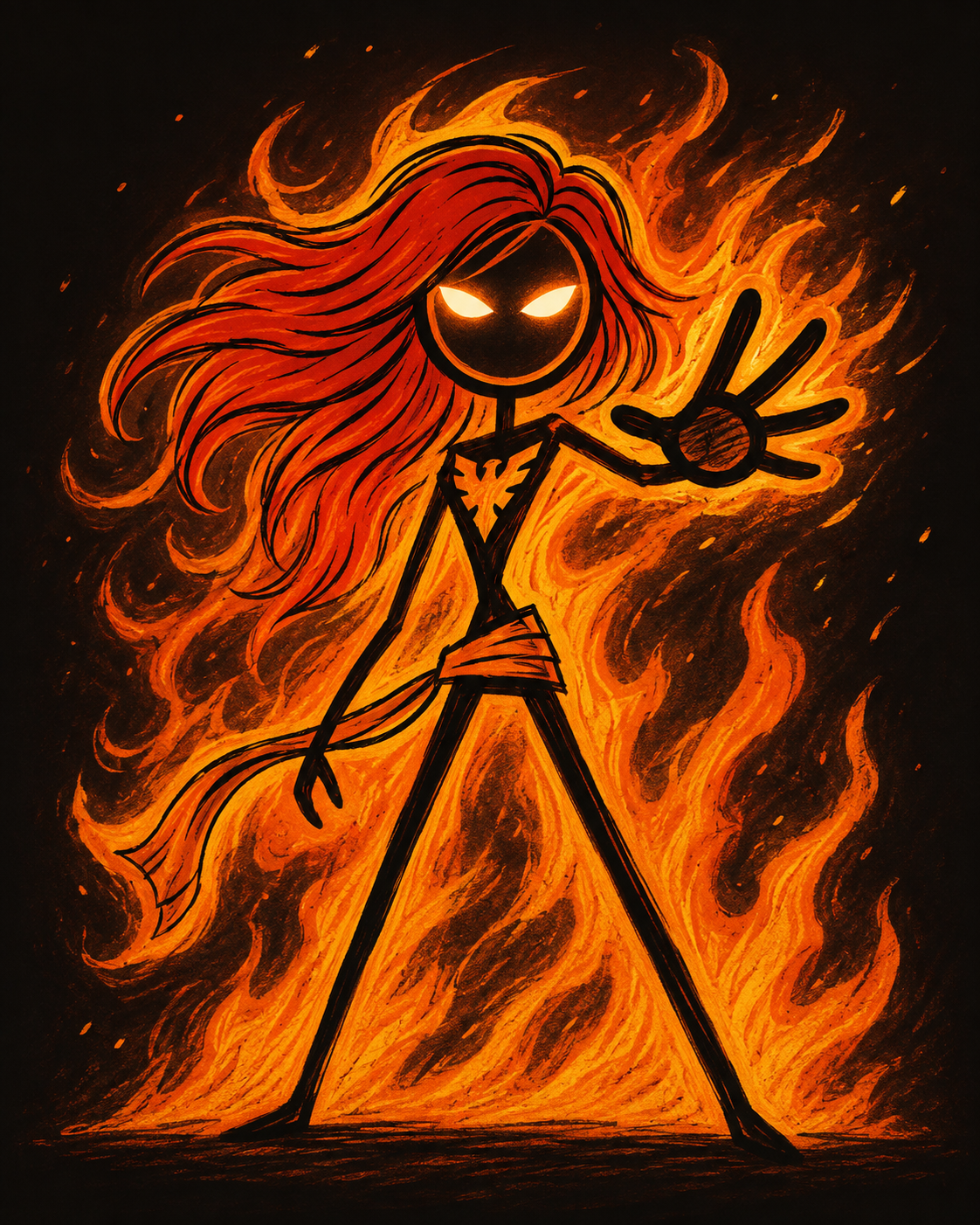
There’s an interesting experiment I ended up doing by accident. One of the iconic Phoenix images is a Greg Land cover to Phoenix Endsong. I asked a couple of different AI sites to make me an image of that cover but make it photoreal. I’m reading, “I'm sorry, it appears I can't help with this particular request, as it may go against my guidelines,” as, “This image is too sexualised to reproduce.” It isn’t but no AI would make the image for me. It might be an issue of infringing on intellectual property. But then again, when I resorted to, “To hell with it. Make me a stick character version,” it was happy to oblige. That’s where the feature image for this article came from. It is still, to any comic book fan, recognisable as Jean Grey as the Phoenix.
Getting the casting physically right is only half the battle. A great example of this is Sylvester Stallone in the 1995 film Judge Dredd. He just wasn’t what anyone imagined the character to be like. He needed to come across as smart. Stallone is his own sort of smart, but he isn’t British comic book Judge Dredd smart. Change your hero too much and it’s no longer the story you’re expecting or the one you want.
There are times when the physicality of a character is so much a part of who that character is. It didn’t matter how good Tom Cruise was going to be in the film adaptation of Reacher, those who read Lee Child’s books wanted a six-foot-five, enormous, intimidating, physically dominant actor in the role. The TV series of Reacher got that in Alan Ritchson. Jim Lee couldn’t have drawn him any better. Sometimes it matters how closely they resemble the original source material.
And sometimes it isn’t enough to merely look the part. In the case of Jean Grey, it isn't enough to find somebody who looks like one of the many different drawings of the character. The one thing that survives those bridges across decades of different artists drawing different versions of her is that Jean never loses that status of “all woman”. And as the Phoenix, she is all goddess. The former is easier to cast. The problem is how you measure or play the “goddess” angle.
“Goddess” is not the same as "powerful woman." I don’t think you need to cast a physically imposing figure. And clearly, in casting Sadie Sink, the people at Marvel didn’t think so either. What is essential is to have something about you that works for the part. Krysten Ritter has it as Jessica Jones. Her tone and attitude come through to the audience, even when she’s saying and doing nothing. Despite the jaded outlook and her cynicism being worn on her leather-jacketed sleeve, there is a commitment to doing what’s right in a shitty world.
I was watching Stana Katic in Absentia on Netflix and, although the character is far from her role as Kate Beckett in Castle (the TV series where she made her name), there's still that intensity there. In Castle it’s tempered with humour. In Absentia you see one formidable woman. I was watching a scene where she was pointing a gun at her partner, unsure as to whether he’s the mole in the FBI or not, and not for one second does anyone think she’s not capable of shooting him.
Jessica Chastain as Maya in Zero Dark Thirty has a similar singular conviction that doesn’t require an imposing frame or any swagger, only an unwavering belief in what she’s doing.
Sophie Turner played Jean the girl. Famke Janssen had nothing girlish about her. “Powerful woman” is right in Famke’s wheelhouse. The 1990s animated series made Jean feel like the grown-up in the team, perhaps even the mother of the team. The crucial part of all of this is that no matter what stage of life we see Jean Grey at, there’s never any doubt that she’s a big deal. We need to believe that she is capable of being the Phoenix, of housing cosmic power and yet still able to be or become (depending on what stage we meet her) a wife, a teacher, a mother, a friend, whilst all the time able to destroy worlds. There’s a lot going on inside Jean and her strength is to hold all of that in place. Sadie Sink as Max from Stranger Things was her own kind of powerhouse. So, that’s a good start. Let’s see what a grown-up Sadie can do. No pressure.
Where next?
→ If you want to explore what happens when someone with godlike powers is shaped by the ordinary human life they were given, A god raised on a farm in Kansas
→ If you want to explore what happens when two people with almost identical powers are shaped by completely different childhoods, A Girl Raised on a Dying Planet
→ If you want to explore why looking like a superhero and actually having the presence of one are two very different things, The Brie Larson Appreciation Society
If the writing resonates, stay with it.