
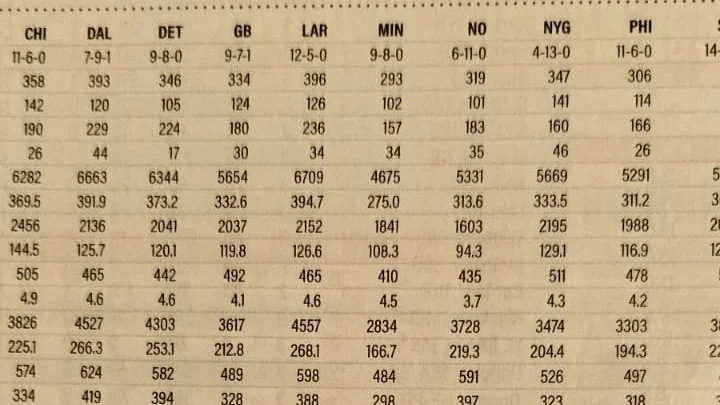
I’m pretty sure I’ve got dyscalculia*. And I love that “math dyslexia” has its own name, so that we can have conversations with dyslexic friends where they tell you that words are jumbled up in their brain, and we can tell them that numbers get scrambled in ours. I’ve learned my lesson though. Never come out as dyscalculic in writing to any dyslexic friends. All of this is my concession to not being the best to write about maths and sports.
We all know that “metrics” have taken over a lot of sports thinking in the last twenty years. From Michael Lewis’s Moneyball** onward, sabermetrics and analytics have been a major part of on-field and front-office strategies. In football now, it’s rare to get to fourth-and-medium without being notified of what the analytics recommend that you do. It’s fourth-and-one at midfield? Computer says go for it 99.9% of the time.
The first thing that automatically comes to mind is that the decision should be based on what you actually see on the field and not what you see on paper. There’s all different sorts of fourth-and-ones. The call is different depending on what happened on first, second and third down.
1st and 10: Holding call. You get moved back 10 and now you’re 1st and 20. You get 5 yards back on the next play. It’s 2nd and 15. The next play is incomplete. Third and fifteen. You throw a pass that goes for 14. It’s 4th and 1. Analytics say go for it. I’d be inclined to agree.
Compare that to this. 1st down: The nose tackle jumps offside. March off five yards. It’s 1st and 5. The next play gains you a yard. 2nd and 4. Next play gets us closer. It’s 3rd and 1. Big stand by the D and the third-down QB sneak gets stuffed. It’s 4th and 1. So far, the offence has gained nine yards on four plays and one of them was a gift of a five-yard penalty. You’ve earned four yards and you’re trying to get one more. Is it the same fourth-and-one as any other?
Arguably – Yes. Arguably – No.
My Dad was always keen to remind me that if you flipped a coin nine times and it came up tails nine times in a row, the odds of it coming up tails on the tenth toss of the coin is still fifty-fifty. That’s all fine for calling heads or tails but any fourth-and-one play is situational. It could be any fourth-and-one against the 1985 Chicago Bears and you’d probably not go for it. The punter’s straight out on the field. Sometimes you got to know who you’re playing against. And you have to know who you are. I’d like to know if the analytics take into account who you have in the backfield. That’s going to be some mind-blowing sports equation there. Fourth-and-one at midfield and you have Bijan Robinson in the backfield. Give him the ball. That’s a different call for a team that’s down to their third-string back.
And don’t get me started on the odds for a Philly Tush-Push.
I think the simple equation that they worked out was: The amount Jalen Hurts can squat-lift (QB1 x 600 lbs), divided by the weight of each defensive tackle you’re running the play directly at (300 lbs x2) plus the weight of the defensive linemen pushing him from behind (600 lbs) plus the decibel level from the average NFL crowd (95 dB) and remembering to subtract 0.35, that being your average rainfall in inches on a wet day, which dictates how slippery the turf is.
So, it’s 1x600 ÷ 300 x2 +600 +95 -0.35 = Oh, fuck it, go for it.
It’s always a risk-reward situation. What’s the risk and what’s the reward? The analytics are there to guide you. Apparently, it takes all aspects of the game into account. And yet there’s something satisfying about saying “screw you” to the analytics and going for it anyway. Many a play has been won and lost following the analytics and many a play will have been won and lost not following them. The same can be said for calling a play on a gut instinct.
In Super Bowl XXIII, Bill Walsh regretted opting for a 19-yard field goal rather than going for it from the Bengals’ two-yard line. A bad snap from Randy Cross and rookie kicker Mike Cofer shanked it and the 49ers let the Bengals off the hook there. Walsh later said that his instinct was to go for it. They didn’t have analytics in 1988. He didn’t need analytics. His gut was doing the analysis for him. He just ignored it.
That’s all a preamble to my thoughts on the latest thing that seems to have caught on in the NFL. What the hell is it about going for the two points in the fourth quarter when kicking the extra point would put you within seven? There was a situation in a Thursday Night game this year where Carolina scored to make it Green Bay 27, Carolina 19. They went for 2. They didn't get it. There was still 5 minutes left on the clock.
It still doesn’t make sense to me. And I understand the thinking. I just can’t agree with it. Kick the extra point and then you are one touchdown and an extra point away from tying things up. Sure, if you get the 2 points and make it you’re now 6 points down and a touchdown and extra point wins it. If you don’t get it – hey you can still try another two pointer if you score again. That one is going to be more nerve-racking because you’d then need to score that two-point play just to force a tie and potentially go to overtime. Is this the best sporting example of robbing Peter to pay Paul? You still have to pay, no matter when you go for it. Going for the two with five minutes left may be less stressful than going for it with everything on the line, but it seems like a cop-out to me. You want to go for the win and not the tie to send us to overtime? Well, do it on the last score of the game with one second left on the clock. The difference between the two is that if you go for it on the first score with five minutes left then everyone says, “Well, that’s the strategy now. If we don’t get it then we’ll just have to get it on the next conversion.” If you go for the two points to win the game, it’s one last roll of the dice and way more dramatic. It’s still the same gamble. You simply took it earlier in the quarter.
As it was, Carolina didn't score again. But there was something interesting in the commentary. When they did get the ball back, Kirk Herbstreit pointed out that Carolina needed to score quickly. Being eight points behind, they had to have a contingency and allow enough time for a scenario where if they failed the two-point try there would still be enough time on the clock to at the very least try for an onside kick. That changes how you're playing the game. At eight points down you have to hurry. At seven points down and with the comfort of knowing a score and an extra point at least sends you to overtime you’re going to play the game differently.
I started to try to get my head around the maths, but it made me think that if I didn’t have dyscalculia before now then this was going to trigger it. Somehow, the equations that the analytics come up with, involving a 50-50 chance of a two-point conversion, a 90%+ possibility of making a very kickable extra point, a 50% chance in overtime meant that you had a 12.5 percentage-point improvement in your chance of winning if you did go for the two points on the first touchdown in our scenario. And apparently, even that is mathematically wrong. So, put your calculators away.
At 27-13 down in the fourth quarter against Green Bay, if you were to tell the Carolina Panthers that they could get this game to a fifty-fifty chance of winning, I think they’d take that. But in reality, not on paper, is it really 50-50? Do you have a fifty percent chance of winning in overtime? In the 2013 season opener between the Tennessee Titans and the Pittsburgh Steelers, Titans returner Darius Reynaud touched the opening kick-off outside the end zone before stepping back into it, resulting in a safety 3 seconds into the game. It was and probably always will be the quickest score in NFL history. Imagine if that happened in overtime. People might be sitting around thinking that they know there’s a 50-50 chance of their team winning. And then a kick returner makes that sort of royal screw up. In one dumbass play the percentages drop to zero.
One fun thing to do if you’re more a fan of chaos than numbers is to watch Super Bowl LI and watch the Patriots’ chance of winning go up as they claw their way back from 28-3. At 28-3 ESPN analytics gave the Patriots a 0.3% probability of winning. There was still 8:31 left in the third quarter. How do you write anyone off when there’s that much time left in a game? Before sabermetrics, metrics, analytics, call it what you will, a 28-3 lead midway through the third quarter would leave you feeling pretty darn good. You could say stuff like, “They’d be hard pushed to lose this now.” No one would say, “Yeah, but what percentage would you say they have of winning?” Equally no one would put a number of 0.3% on it.
The maths is interesting, but I can’t help but think of the Brett Favre-era Green Bay Packers, and how his game-winning drives came down to having a mentality of keeping the chains moving. Get one first down. Get a chunk play here, a big third-down conversion there, or a scramble to keep the drive alive. Move the chains. That’s all you had to do. It was never a case of what odds you’d give Favre to go the length of the field. It was the odds on each play. And who’s got time for that?
*Please note that, out of respect for both those with dyslexia and those with dyscalculia, statistics, numbers and figures and stats will be stated as words and as numbers. That way we can all be confused together.
**I do know that sabermetrics existed before Michael Lewis wrote Moneyball. I’m just not going to let accuracy get in the way of the flow of words.
Where next?
→ If you want to see what happens when the odds say one thing but the game has other ideas, J.J. Buchanan! And this time there really isn’t any time left on the clock
→ If you want to explore whether an algorithm can really understand what we like, or simply keep giving us more of the same, Sometimes we stumble into where we want to be and other times the algorithm gets it right
→ If you want to consider where creativity actually happens, and whether the tools we use deserve any of the credit, Does a stuffed bear need to get the credit for his work?
If the writing resonates, stay with it.