
Fun with Franzen
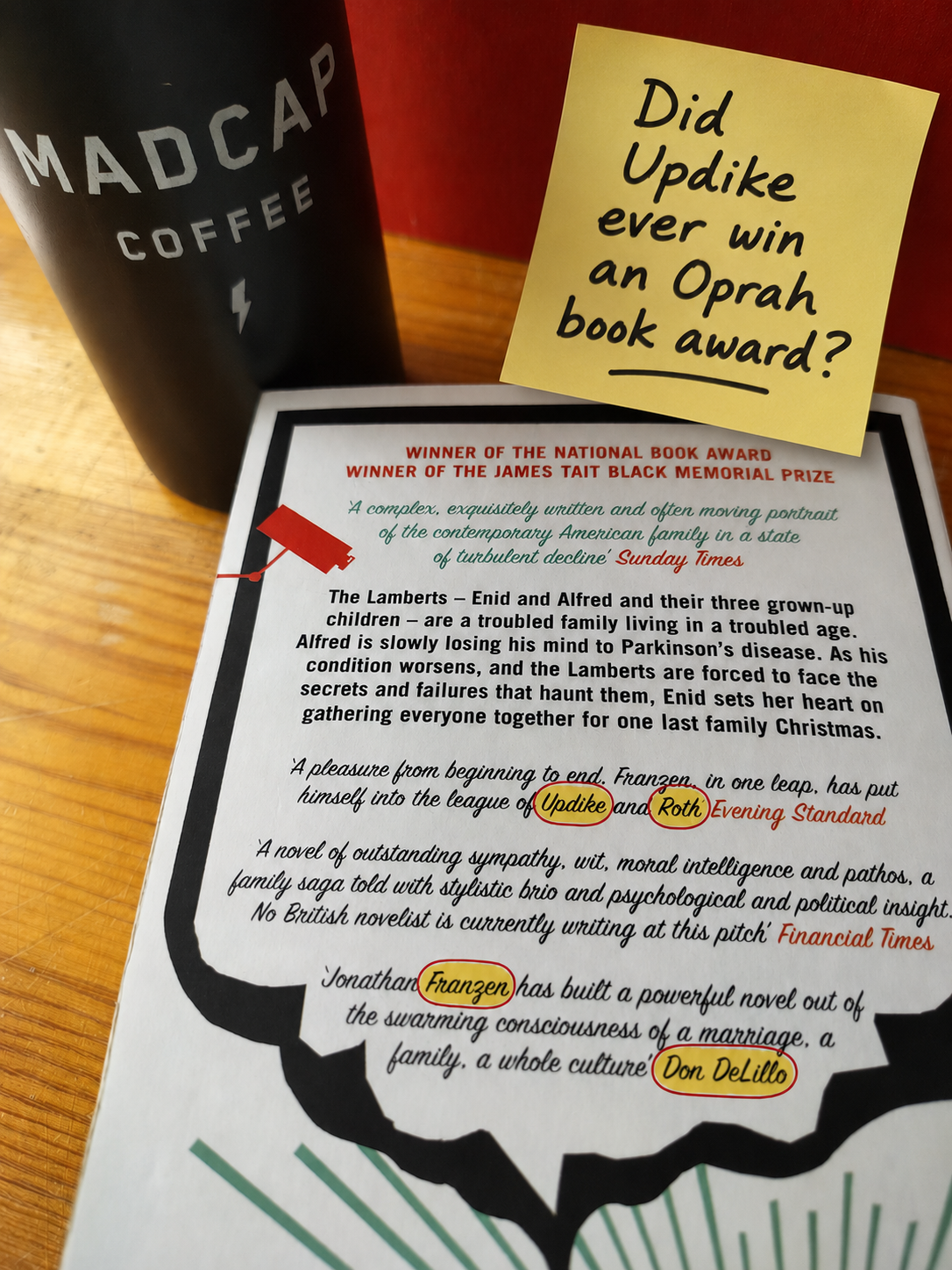
There is a certain amount of fun to be had with not having to adhere to academic thinking. Here, we can just delve straight in. And the best starting point is the whole Jonathan Franzen v Oprah Winfrey saga. The debate is some twenty-five years old now but it encapsulates so much of what my PhD was doing.
The short version: American author Jonathan Franzen wrote a book. Oprah Winfrey made it one of her book recommendations. Franzen immediately went – Shit! I wanted men to read this novel. No dude is ever going to read a book that features on Oprah.
Franzen basically says: Dudes don’t do fiction and this is why! What I go on to look at is the idea that it is seen as a simple fact of life. Men don’t read general fiction. As though the problem was men and not what was on offer to read. Franzen doesn’t even question the assumption. He simply accepts it and starts trying to explain why men don't read.
There was and maybe still is a marketing and publishing blindness to the idea that you could start publishing novels that will appeal to male readers. Where’s our new Fight Club? Or Catcher in the Rye? Or Catch-22? In the world I see you’re reading these books, perhaps in a carpool lane of some abandoned superhighways, regardless of your gender.
Here’s the background, plus some commentary from me, free of academic restraints:
This is where the trouble starts. In 2001 Jonathan Franzen’s novel The Corrections was chosen by Oprah Winfrey to be her book of the month selection for the Oprah Book Club. Let’s forever refer to it as OBC. I don’t know why the words book club mean something particularly non-literary to a lot of people. It will open up future debate about lowbrow, middlebrow and then eventually no-brow literature. I do know that Franzen did not feel comfortable with his book being promoted by Oprah Winfrey on daytime TV. Accusations of elitism were bound.
Having read The Corrections, it seemed like a normal literary fiction novel to me. And literary fiction is just another term for general fiction, which in turn is what publishers and bookshops will call anything that they can’t put into a specific category. Franzen homes in on the dysfunctional Lambert family. And it’s hard to look at any American family and not have some commentary on American culture. The novel clearly wants to say something, and it wants to be edgy, and it sort of is. It’s more edgy than you’d expect an Oprah book to be.
For the purpose of writing a PhD I was more balanced in my appraisal of things.
Franzen saw himself as a highbrow author and considered a typical Oprah selection to be middlebrow. He accepted the OBC endorsement but whenever pressed in interviews he would stress that he was not comfortable being labelled in such a way. On 12 October 2001 in an interview with The Oregonian Franzen was quoted to say:
“I feel like I'm solidly in the high art literary tradition, but I like to read entertaining books, and this maybe helps bridge that gap, but it also heightens these feelings of being misunderstood."
Translation: My novel is not an Oprah OBC novel!
And why did they call him elitist again? Here he is trying to draw attention to the differences between literary books and entertaining books. Jonathan, Jonathan, Jonathan. You might be different to those “entertaining” authors, but you can’t say it!
Much debate was to be had. Franzen was elitist. He missed a chance to bridge a gap between highbrow and middlebrow. My favourite angry quote was this one: ''The assumption that high art is not for the masses, that they won't understand it and they don't deserve it, I find that reprehensible.”
I’m not sure this one, from Laura Miller, helped either:
“America’s book culture too often seems composed of two resentful camps, hunkered down in their foxholes, lobbing the occasional grenade at each other and nursing their grievances. One side sees itself as scorned by a snooty self-styled elite and the other sees itself as keepers of the literary flame, neglected by a vulgarian mainstream and would rather wallow in mediocrity and dreck. Each side remains exquisitely sensitive to perceived rejection from the other, and the fact that one is often characterised as female and the other as male resonates with the edgy relations between the sexes of late.”
Those two resentful camps were being personified in Franzen and Winfrey, positioning Franzen as an exponent of high art and Winfrey as a promoter of entertaining books and middlebrow literature.
And then Franzen chucks this grenade:
"So much of reading is sustained in this country, I think, by the fact that women read while men are off golfing or watching football on TV or playing with their flight simulator...I continue to believe that, and now, I'm actually at the point with this book that I worry...I had some hope of actually reaching a male audience, and I've heard more than one reader in signing lines now in book stores that said, "If I hadn't heard you, I would have been put off by the fact that it is an Oprah pick. I figure those books are for women and I would never touch it." Those are male readers speaking. So, I'm a little confused about the whole thing now."
Thank you Jonathan Franzen and Oprah Winfrey for basically handing me a chapter of my PhD on a plate. It’s as good as anywhere to start with Franzen and Oprah. Next up we’ll look at all the assumptions that people make about who reads what.
Liked this? Continue the Series Here.
If the writing resonates, stay with it.