
I'm thinking you have to be ok with cutting off at least one finger to be the best that you can be
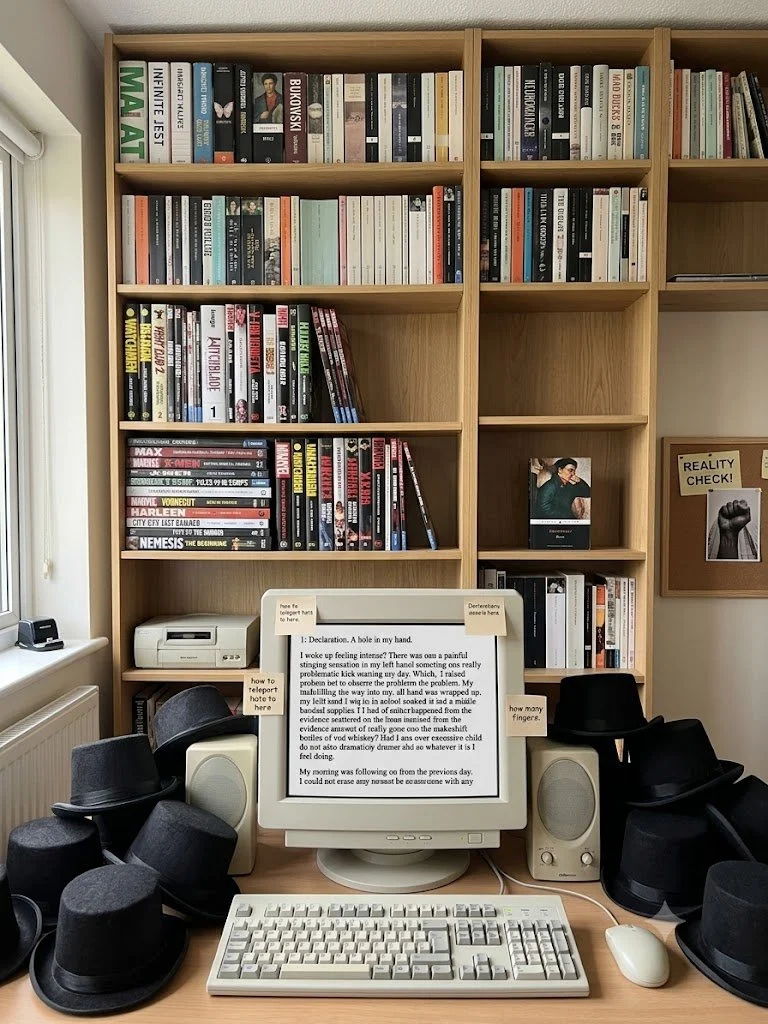
If I learned one thing from the film, The Prestige, it's that whatever your art is, you give everything to it. A finger should be no big deal. There's that and that if you give Hugh Jackman and Christian Bale the right script, they are phenomenally mesmeric. The whole film is about greatness and what it takes to obtain it. Or to be born with it. Alternatively, you can get lucky and stumble across it. To say the film is about obsession doesn’t quite cover it.
If you haven’t seen the film, then stop right here and go watch it and then this article will make sense to you. Alternatively, carry on. Who needs to understand everything anyway?
The idea of these two magicians in Victorian-era London obsessed with one-upping one another, carrying on a feud over the years, is easy to read as a story of vengeance and obsession. That is however the vehicle that’s being used to carry a story about what anyone is willing to give for their art. It’s right there from the beginning. The Chung Ling Soo scene says it all.
Hugh Jackman’s Robert Angier and Christian Bale’s Alfred Borden, both marvel at Chung Ling Soo’s magic trick where he makes a goldfish bowl disappear. As they watch the old man’s act, the two of them, both dedicated to their own magic acts, watch with a technician’s eye as to how he does it and how they can replicate it. It’s Borden, the working class, studious, cunning magician, the one that relies on trickery, who sees the real act. Chung Ling Soo is not an old man. That is the act and it’s an act he carries over into real life, so no one will suspect that he’s actually a much younger man and capable of walking with a goldfish bowl hidden between his legs and under his robes. Borden refers to it as “total devotion to his art.” The performance is his whole life.
This is the cliff that both men fall off. At the start, as friends, looking on in wonder at Chung Ling Soo’s act, there is a beauty in being part of the mystified audience. That only lasts so long. It quickly turns to curiosity and then it’s a slippery slope to obsession. That obsession with bringing one another down only comes about after a fatal accident in which Angier’s wife dies and he blames Borden. They hate each other from that moment on. But their devotion to their art is greater than their devotion to their hatred.
From the start Borden understands and his obsession is driven by giving everything of himself to his art. He takes Chung Ling Soo’s example and lives it. His life becomes the act. Borden’s trick is not magic. It is skill and craft and devotion to this above all else.
Angier, on the other hand, is about performance. He loves the awe and wonder. He loves magic. But after the death of his wife, the charismatic likeable showman starts to unravel, and we see an obsessed and bitter Angier. He becomes more grandiose, more self-important, and more consumed by his own legend. The rivalry becomes personal. Angier needs to know how Borden is performing the one trick he cannot explain because he cannot accept that the answer may simply be that Borden is better, more devoted, more of a magician.
It all comes down to how a man can transport himself from the stage to the audience in the blink of an eye. The trick that drives the rivalry is The Transported Man. The magician enters one cabinet on stage. The cabinet is closed. And then instantly the magician appears elsewhere in the theatre, and the audience believes he has somehow teleported.
Angier can’t work it out. He has no idea how Borden is doing this. Even when Angier lucks out by finding a double to help him do his version of the act, he still remains obsessed as to how Borden does it. He is sure that there is trick, that there is something more to it, something he is missing. He keeps looking for the clever answer that just isn’t there. This leads him to Tesla, and this is when things get really interesting.
David Bowie as Nikola Tesla, the real-life inventor, is the key to understanding everyone’s magic. Angier believes that Tesla can create a teleportation device. He invests heavily in Tesla’s work. Perhaps the real magic in all of this, up to the point where real magic does come into play, is Tesla’s belief in what he can do. Even when the experiment appears to be failing, it is his belief that it can be done that seems the most mesmerizing and mystifying. It’s not a case of Tesla believing in the impossible. He doesn’t see it to be impossible at all. He sees any setbacks as a puzzle to solve. Teleportation is not an impossible dream. It’s not a con nor a ruse to extract more money from Angier. It’s a problem that Tesla knows he can fix but just hasn’t quite got it right yet.
I feel like I’ve set up now for the final big reveal. Revealing how each does his trick is not the reveal I’m interested in. You watch the film for that. The reveal we want here is to see how each character creates their art.
The simplest route is Angier’s. Tesla does eventually make the teleportation device. Angier uses it. Each performance is magical science. The one drawback is that every time he does the trick it creates a duplicate of himself and that duplicate has to die, drowned in a tank each time they do the trick. The cost of the trick is that he no longer knows who the clone is and who the real Angier is.
Borden’s magic, and this is the backbone of the whole story, is art. It is the art that he gives his life to. His trick is that he has a twin and between them they share a life and make the magic act work. He had followed in the footsteps of Chung Ling Soo. He and his twin had given their lives to their act, never letting on that there were two of them, so that no one would suspect a thing. Any discovery that Borden was two identical people would ruin the whole act. Between the two Bordens they have half a life each and one public persona. So, when one Borden has two of his fingers shot off by Angier, the other Borden is required to remove two of his, to keep the illusion alive. There is no hesitation. I wouldn’t even call it a sacrifice. It’s something that has to be done to continue with the performance.
Meanwhile, the real magic is all Tesla’s. He merges science and magic. He is the true magician, in that he knows he can achieve the trick, he just needs to iron out the kinks. You get a feeling, even when it doesn’t seem to be working, that Tesla is the genius who will make it work. And the moment of realisation hits home so well, when you discover that his “trick” really does work. Having tried over and over to make a top hat disappear, and each time thinking the experiment had failed, we discover, as Angier stumbles across a large pile of top hats, that it had worked but not exactly in the way Tesla thought it would. The hats had been replicated and teleported, whilst the original remained in place undisturbed. It’s more like a photocopier than a teleporter. But it’s all that Angier needs to make his act work.
Both Borden and Tesla know that the trick in itself is enough. That the trick, no matter how it is created, through magic, technology or devotion to your art, is what matters most. As Tesla puts it to Angier, when he hands over the teleportation cabinet: “The truly extraordinary is not permitted in science and industry. Perhaps you’ll find more luck in your field, where people are happy to be mystified."
Tesla is not offering answers or explanations. He is offering only the device to perform the act. Angier can still receive the adoration from his audience, and that sense of awe that he can give them is what he thrives on. But he can never be Borden, never be the creator of his own trick.
To go looking at the sacrifice angle or the obsession angle is all well and good. But you can’t ever convince me that the whole film isn’t about the nature of art and what it takes to be a great artist. People who see the sacrifice and obsession as the key to creativity are putting the horse somewhat before the cart. Life is full of sacrifice and obsession. Writers and creatives do not have a monopoly on that. Most people don’t even stop to think what they sacrifice. Borden doesn’t. One finger or two or the whole hand, whatever needs to be done.
Sacrifice, in these terms, isn’t an offering. I’d say it’s not even really a sacrifice at all. Sacrifice alone is just an offering to the Gods, with no plan and no hope. Of course you don't need to lose fingers to be a creative, not literally or metaphorically. (I probably should have started with that disclaimer). It’s never about, “how far will you go?”
The thing that interests me is the mysticism surrounding how you create art. Sacrifice and suffering are pushed as aspects of true art. Sacrifice and suffering do not create art. There’s this idea that if you put enough suffering into your work a masterpiece will be the result. I think there’s more suffering in the world than there are writers for that to be true. The suffering, in various forms, may already be there. Writing needs friction. Creating the masterpiece creates more of the suffering and makes it into art. And by suffering I don't mean it in a dramatic sense of tragedy shaping your work, of work only ever being born from grief or heartbreak or hardship. It can be as simple as thinking on things. The inability to stop noticing things, to stop thinking about things, to stop seeing things from all different angles, and to form words and ideas, even if you don’t want to, that is suffering, with a small “s.” Great artists often suffer because they cannot stop engaging with the world in the way that produces the work. So, a writer writes and he does it all the time. It's not sacrifice. There are gains and there are losses.
Where this leaves Angier is problematic but also crucial. He is as devoted to the act, to the trick, as Borden is, but his focus is always the performance, the audience reaction to the awe and wonder. As much as I do believe that a trick performed in an empty theatre is still a trick, a novel written but unread is still a novel, a website dedicated to life as narrative is still a website, at some point it becomes more. The Prestige sets Angier against Borden, but the truth is that both exist as aspects of art and creativity.
I do see art, creativity, writing, not as a choice, but as something you can’t stop yourself doing. Does that necessarily make you great just because you can’t stop yourself? No. If you look at our lineup here, Borden stands in the middle of Tesla and Angier. Tesla makes magic. Angier performs it. Borden has willingly given his life to it. To Borden this is all inevitable. He sees things. He can’t leave an idea alone. He works on the idea. He struggles with making the idea work as best it can. He obsesses about how it can be the best it can.
Art does not create itself. As much as I wish that there was some of Tesla’s magic to make it happen, there isn’t. As much as I’d love to have Angier’s natural ability to make it look good, there’s hours of work that goes into it. Borden is the reality of creativity to the Nth degree. Whether you’d want to go there is questionable, but at least you have a road map on how to get there.
If the writing resonates, stay with it.