
No one would actually take a ride in the Millennium Falcon
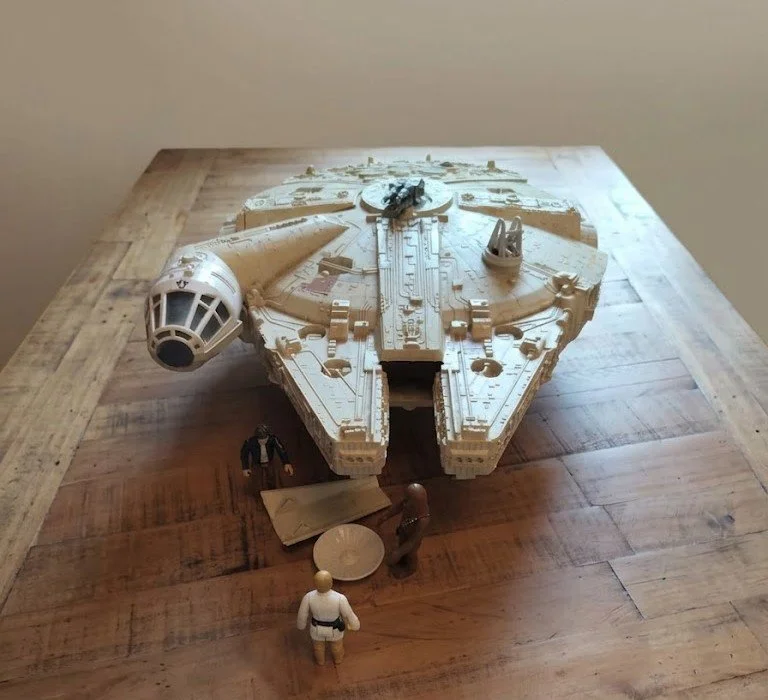
In the original Star Wars, the first thing Luke says when he sees the Millennium Falcon is that it’s a piece of junk. It’s typical of storytellers to make the good guys, who are typically the underdogs, travel around in a “piece of junk,” whilst the bad guys fly about in super sleek, efficient looking, perfectly symmetrical vehicles. That might be attributable to the nature of storytelling, and a desire to tell tales about the unlikely heroes, the ones who fly around in spaceships stuck together with spit and glue. These are the ones that shake up the natural order, change things, make them better.
In the remakes of the original Star Wars trilogy George Lucas added scenes at the end of Return of the Jedi showing various different planets where the people were celebrating en masse. And the first thing that comes to mind is: Where were you all when the big fight was going down?! Huh? Not fighting the evil Empire, that’s for sure. These are exactly the same people that wouldn’t get on to the Falcon in the first place. It’s not that they wouldn’t believe in the cause. They simply don’t think they can win if they have to fly around and win dogfights in something that looks like the Falcon.
I wonder if Luke’s response is purely based on how the Falcon looks. More so, there’s a desire for the familiar, for safety. Douglas Adams wrote about the Vogon Constructor Fleet, hanging in the air in just the same way that bricks don’t. It always conjured up an image of flying bricks moving through the Galaxy, destroying planets as they go, to make room for a hyperspace bypass. Arthur Dent, on seeing the inside of the Vogon ships, was surprised that the first ship he’d ever been on was uncomfortable, dark, smelly and downright skanky really. Later, when he sees the inside of the Heart of Gold, he says that it’s much more how he imagined spaceships to be. It was white and gleaming and had bright lights throughout the ship, robotic doors with a sunny disposition, and a manically depressed robot. Generally, sleek, white, bright, gleaming, symmetrical, and aerodynamic are the things you look for in a ship that you’d want to hitch a ride with.
But it’s all packaging most of the time. Packaging, in the real world, gets us every time. It’s about making something look desirable. Desirable is not always the gauge we can reliably use to measure quality. It’s often the safe choice and if you had the Heart of Gold parked next to the Millennium Falcon, you don’t pick the Falcon. The Falcon might be a riskier choice. It might be where the adventure’s at. It might be able to swim through space like no other craft in the Star Wars Universe. But it’s not symmetrical. It’s not traditional. It might not be safe.
Speaking of “safe.” I remember, back in my hotel concierge days, having a conversation about whisky. I used to love whisky, Scotch, Bourbon. I’d drink Jack, Jim, Woodford Special Reserve, Maker’s Mark, Wild Turkey. Lagavulin became my favourite single malt Scotch. After that conversation, the hotel guest came back later and gave me two plastic vials of homemade moonshine. Well, you just can’t buy that anywhere. Best tip ever.
Ask yourself, what do you choose if you have the choice? The Glenmorangie or the clear liquid in a vial that could be anything? For me there’s no choice at all. Forget the container the liquid comes in. It’s the liquid we want. If somebody puts a beautifully packaged bottle of whisky in front of me, I know roughly what I'm getting. If somebody hands me a clear liquid in an unlabelled plastic vial and says, "My uncle made this in a shed in his back garden in Bardstown, Kentucky," I’m dropping the fancy bottle to grab the vials. I’m not saying which one is better. I’m saying I know which one I’m having.
It’s not a case of mainstream - bad, small independent weird thing - good. I was lucky enough to live through a time when the underground became the mainstream. The rise of “indie music,” the eventual merging of alternative and popular music, saw a blurring of the lines and success came about because of the quality of the work being good, regardless of what the artist looks like, or what genre is allocated to them. To this day I do not know what genre Faith no more or Rage against the machine are.
This all came about from looking at this website, looking at thesolidwallofwriting. I was thinking about how I’m liking how it looks now. I like what I’m saying. I wouldn’t publish these pages if I thought otherwise. Remember, when you write for others you enter a contract. The reader says that they will read your work, and you promise that what you give them to read isn’t shit. The thing is this all started out very much as a blog, a patchwork quilt of a site. It was the messy scrapbook that came before the wall. Maybe some people would find the scrappiness charming, or full of character. I just felt that the packaging could be better. The stories would be the same. The type of things I write would be the same. Some of the editorial writing would be different though. The feel of it would be different. That’s the main thing. The name was different. It was a very obscurely named, “You can’t write like Dostoevsky if you only use emojis.” The tagline still exists on the wall. I didn’t have faith that people would get on board with that ramshackle version of things.
Being ramshackle or being well polished does not guarantee anything. Something isn’t going to be more interesting because it came out of left field. Equally, there’s more than enough bad big budget films out there to prove that you can throw money at a script and still produce a snore-fest. The difficult line to walk is between something that genuinely is a small independent project and something made to look like one. There’s many films that look like they’re small films but aren’t. Lost in Translation, Garden State, The Shape of Things, Seeking a Friend for the end of the world, Closer, V for Vendetta, Up in the air, Eternal Sunshine of the Spotless Mind, A Scanner Darkly. Those are some of my favourite films and they all feel like independent films and not huge Hollywood films. But look at the talent attached. You have Bill Murray and Scarlett Johansson, Keira Knightly and Steve Carrell, Natalie Portman, George Clooney, Kate Winslet and Jim Carrey, Keanu Reeves. Those names alone, attached to any film, could hardly be called small indie films. They do however use the techniques, tropes, style and mood of that type of film. The analogy that comes to mind is that no one is going to get into the vehicle if it looks shaky, but when you see George Clooney is driving, you’re thinking – this ride must be good.
When all is said and done, you cannot avoid the packaging. You cannot forget about presentation. The book cover matters. The look of the website matters. The title matters. The presentation matters. Under it all is the material. The content. The work.
The original Star Wars films were full of ramshackle vehicles. AT-ATs were a bonkers idea. Sure, they look cool and impressive but they’re pretty easy to trip up. Boba Fett’s ship Slave 1, that looked like a flying iron. The B-Wing fighter, on screen for all of thirty seconds, looked like a crucifix on its side with a cockpit that revolved and you’d have to question how the pilot didn’t get nauseous every flight. The Mon Calamari Star Cruiser looked like a flying gherkin. They had character. They had character because they were designed by artists and not engineers. A friend of mine once told me that you can only put a car through a wind tunnel so many times before you come out with the same car over and over. In fiction we want individuality. We want things to look different and be different. When it comes down to it, the thing about the Falcon is that it is a character and like all characters we like it because of the things it does.
In the first Star Wars when they have the dog fight with the Tie Fighters, Luke and Han go to the guns and it seems to defy all laws of physics and you don't know what's up and what’s down. Then in Jedi, there's a quick clip of the Falcon giving a blast from the cannons, giving a call back to those scenes in the original dogfight, and you smile thinking that's what the Falcon can do. But mainly I think of the Falcon swimming so smoothly through space.
This started with aesthetics, with basing opinion on how things look. It started with me thinking about the old blog site, the prototype for the wall. It got me thinking about character and how my shabby blog site had tonnes of it, but it wasn’t sleek like an Imperial shuttle. It was definitely more rag-tag, more Millennium Falcon, without the fame and fandom. Maybe I was nearer the B-Wing with its thirty seconds of screen time in Return of the Jedi, there in the background looking spectacular and weird. Luke’s initial reaction to the Falcon, the heap of junk, is only right on a surface level. It’s an amazing heap of junk, capable of so much. Apparently, it can do the Kessel run in less than twelve parsecs. As much fun as it is to compare creative projects to Star Wars vehicles, I’m being unfair with my analogy. The website was never the ship. The website is just the hangar that houses the ship. The words are the Millennium Falcon. The site is the hangar. It’s silly to miss the old shack, to feel I’ve turned my back on it. It’s my love of the underdog that makes me feel for all those creative projects, those websites, those smaller films, those fringe plays, the musicians with all the talent in the world not getting the attention they should. That’s not to say every fringe play is a hidden gem or every local band playing every weekend down the Dog and Duck will be great by virtue of being different from the mainstream. What I do need to remind myself of is that what matters is what’s in the hangar, no matter how shabby or glorious that hangar is. It’s always been about the work.
Where Next?
→ If you want to explore why the effect matters more than the mechanism, read I'm Thinking You Have to Be OK with Cutting Off at Least One Finger to Be the Best That You Can Be.
→ If you're interested in the difference between appearance and reality, continue with Life is not a pop video.
→ If you want to explore why writing should ultimately be judged by what it does rather than what it looks like, read The Beauty and Power of Words – Part 3.
If the writing resonates, stay with it.