
You have to enjoy the violence
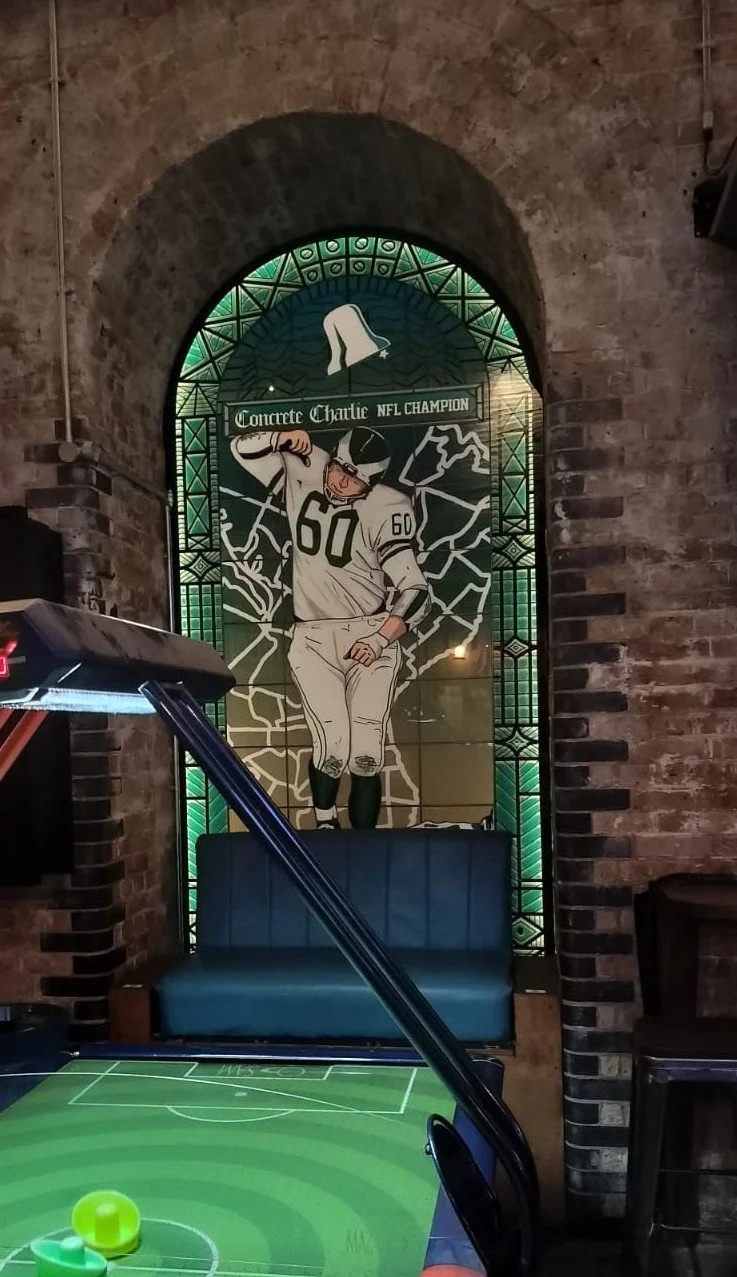
A stained-glass tribute to Chuck Bednarik at a Philadelphia-themed sports bar in London. His hit on Frank Gifford remains one of the most iconic images in American sport. It's seen as both brutality and beauty.
I remember play fights from when I was a kid. It was more a case of bundling on top of the pile. Then I remember teen fights, first of all as an angry response to bullying and then later as “macho bullshit” posturing. For a while people around me had convinced me I was a tough guy. I never was. Made it into the top ten hardest kids in my school once. I believed it for a little while. I know that at least one of those boys in the top three went to prison and subsequently died in violent circumstances. He must have loved violence in all the wrong ways and loved it too much. He clearly wasn’t right in the mind and sadly that’s never going to be fixed now.
After I turned eighteen, I never threw a punch in anger again. Years later I did have a drunken argument in a gay bar with my best friend that ended with me bopping him on the nose. As much as I’d like to say it looked like Neo in The Matrix, it was probably a flailing drunken arm that landed on Jimmy’s face. Within seconds four doormen were on to me. I immediately put my hands up. We both said it at the same time: “It’s OK. He’s my best friend.” I apologised all the way home. Other than that? Not a single punch thrown in my adult life.
I think of Fight Club, of Tyler Durden asking, “How much can you know about yourself if you’ve never been in a fight?” Part of me feels like that is true, and it’s mainly because I don’t ever need to ask what it feels like to be in a fight. It’s not like the movies. You see drunken brawls or kids in the playground and it’s all arms and legs thrown at a frenetic and angry pace. It’s uncoordinated. It’s wrestling with intent to hurt. It’s throwing each other around. It’s angry and it’s ugly. It’s hot and sweaty and never feels good at the end. It’s embarrassing.
When it comes to sport though, and football in particular, I think it is more like the rough and tumble of kids in the playground. Maybe football players are kids who never grew out of that and had a place where they never had to. I remember being at the old Candlestick Park and the guy sat behind me shouted, “Hit someone” on a kick-off. I turned to look his way. He didn’t look like a big guy at all. Then, as performance, he said, “You gotta excuse me. I used to play special teams.”
If you want to read about a normal man crossing the line into that other violent world, and I’m not just saying this because I’m a Detroit Lions fan, Paper Lion by George Plimpton is one of the best sports books ever written and gives you some real insight into a football life. Plimpton, with an accent so posh I was sure he was English, somehow got management to agree to let him join the team during the 1963 pre-season. To remain undercover, he had intended to blag his way into practice as a legitimate QB. But it became apparent very quickly that he was a journalist on a deep research mission to discover life inside of an NFL team. It ended up being a great PR move by the team. Plimpton, however, only got a taste of what it’s like to play football. Perhaps Plimpton had thought that playing QB he could concentrate on athleticism, intelligence and strategy. Perhaps the one side of the game he hadn't been ready for was the violence.
In a quiet aside, after a disastrous day on the practice field, where Plimpton was humiliated, Detroit coach George Wilson talked to Plimpton and explained how football is more than athleticism and tactical smarts.
But the love of physical contact happens to be a quality that’s suited for football, and you can tell it early. When kids, out in the park, choose up sides for tackle rather than touch, the guys that want to be ends and go out for passes, or even quarterback, because they think subconsciously, they can get rid of the ball before being hit, those guys don’t end up as football players. They become great tennis players, or skiers, or high jumpers. It doesn't mean they lack courage or competitiveness. But the guys that put up their hands to be tackles and guards, or fullbacks who run not for daylight but for trouble – those are the ones who one day will make it as football players.
My translation, the one I’ve carried around for decades is: You have to enjoy the violence.
This isn’t the thuggery of a man looking for a fight in the kebab shop on a Friday night. It’s more like the school playground game of pile on. To play contact sports you have to go looking for that contact. You have to want to create collisions. This goes against everything you’d do in normal life. It was the late great Walter Payton, forever known as ‘Sweetness’ - which tells you as much as you’d ever need to know about the man, who said, "I love the contact. I knew that if I made the contact, I'd be alright." He was going to explode into every tackle. He would actively choose to stay in bounds and collide with his tacklers.
I think that the thinking would be that you’re going to get tackled. You may as well enjoy it as much as the guy who’s tackling you. Also, we forget that these people will have played a lot of different positions through school and maybe even in college and they will have tackled others and know how that feels. The collisions are second nature to them. Most importantly, it’s consensual. Both players have chosen to be there.
I think of Detroit’s Aidan Hutchinson making an interception and getting levelled just after making the catch. He was shown the video of the play when going to the locker at the end of the game and he just said, "Wow, I got levelled good there."
We’re circling Fight Club territory here. Winning and losing is not part of Fight Club. The violence is as much about taking a hit as it is about landing one. The first time Tyler asks the Narrator Jack to punch him, Jack screws it up and punches him in the ear. There’s no beauty there. It’s sloppy and random and because of that it also seems funny. It’s violence but it doesn’t feel violent. Tyler’s riposte, a punch to the gut, seems more violent and yet it seems welcome. There’s almost a sense of, “good punch.” The two seem to be closer for trading blows.
The MTV studios series Jackass seems to work on the same level when it comes to consensual violence. I got rather worried when young people went through a phase of slapping sleeping people on public transport and filming it and posting on social media. Thugs. Dumb ass braindead thugs. They didn’t realise that examples like Jackass were about doing it to yourself, daring to do it, to do it to your friends and to know your friends were going to do it to you. One of the earliest Jackass stunts had Johnny Knoxville sprayed with mace, tasered and shot in the chest whilst wearing a bulletproof vest. It was his idea and he seems a clever guy. It almost doesn’t seem like violence when you put it like this. In everyday life violence is wrong. Self-harm is wrong. But sometimes it’s art.
Steve Atwater destroying Christian Okoye is a work of art. If you look at the choice of words there, “destroying” seems heartless out of context. But we’re not talking literal destruction. It’s the hyperbole of the language we speak. Context is everything. One time a Scotland game fell on the same day as the Grand National. Horses tend to die each year in that race. Asked how Scotland had fared that day I replied, “We got slaughtered.” My sister’s now ex-husband replied, “So did my horse.” That’s two very different types of “slaughtered” there. Steve Atwater and Christian Okoye are both still walking this earth, but I am still going to say that Okoye, nicknamed the Nigerian Nightmare, got destroyed by Steve Atwater on one play in a game in 1990.
There had been big running-backs throughout the history of football. But Christian Okoye was really big. Feature backs didn’t tend to be the size of linemen. He rumbled and ran over and around people and he just looked big. People like Walter Payton and Jim Brown and Earl Campbell were big and ran big, bigger than they were. Okoye ran big and looked it. In a head-to-head collision with a free-safety you’d expect Okoye to trample over the defender like he wasn’t there. Steve Atwater, however, had a reputation. He was good. Hall-of-Fame good and he flat out loved hitting people. (That sounds violent when you say it out loud. You say that of the psycho in the chip shop on a Friday night and the connotations are totally different) Atwater was not small. I always think of him as lean though. Six foot three and two hundred and eighteen pounds in his playing days. There’s only a thirty-five pound difference in weight between Atwater and Okoye. It wasn’t a David and Goliath type meeting on the pitch. But you do normally expect the defender to go backwards in this sort of run-in.
One thing that makes this such a work of art is that Okoye runs through a massive hole. He’s just getting rolling and then Atwater steps up. When you look at it again, Atwater doesn’t seem to be going flat out. It occurs to me now that it’s something similar to Superman standing in front of an oncoming bus and lowering his shoulder to stop it. He doesn’t move. The bus does. The bus slams to a halt. In this case, with Okoye being the bus, the bus goes backward. The action is so smooth. Okoye rolls through the hole. Atwater comes out of nowhere and is head and shoulders square to the runner. He lowers his shoulder and BOOM! It’s a thing of beauty. It’s beautiful violence. It’s art. It’s technically beautiful. The crack of pads on pads can be heard right up to the top deck of Mile High Stadium. And when they show the replay on the big screen in the stadium, the crowd watching it, collectively everyone goes, “oooooooh.”
One of the more interesting things about that play is that I couldn’t tell you what the down and distance was or the result of the game. It looks to me like Okoye made at least four yards. So, it wasn’t even a tackle for a loss, making it the most talked about four yard running play in the history of the game.
Christian Okoye in recent interviews has said that the Atwater hit wasn’t even the biggest hit he’d ever taken. In one interview he goes on to discuss that he was once involved in a collision with Chicago’s Richard Dent, in which both men got up not knowing where they were. Dent even followed Okoye back to the Kansas City huddle and had to be told, “Your team’s over there.” Don’t go feeling sorry for Dent here. He was one of the all-time greats and key part of one of the greatest defences ever. He delivered more concussive blows than he received over a long career.
No one wants anyone to get injured. Hurt? Yes. Or maybe. The threat of CTE and dementia and all sorts of brain damage is real. But there’s a type of hurt that you expect, that’s part of the price of admission into that world. The game is nothing but bumps and bruises. Think back to being a child and how many scrapes and grazes and bruises you’d have. You play and you’re going to have the scars to show for it. My best friend, when I was a child, accidentally hit me in the eye with a one-wood golfclub. I had that little scar for years. I have another scar on my lip from a drunken mishap that involved a computer monitor falling on my face. Kids, do not drink and write. Bad things happen.
In the right arena, two grown men running into each other is spectacle. There is something about laying your body on the line that you can really appreciate. Ronnie Lott of the 49ers was a ball seeking missile on the field, and a lot of the time the ball would happen to be in the hands of a runner. Lott was happy to knock you out and knock himself out. The Jackass guys would have taken notice. You don’t do to others what you’re not brave or stupid enough to do to yourself.
In context, it’s all fair. There are lines that sometimes get crossed. There are cheap shots and late hits and dangerous tackles, but on the whole, even in this modern era of safety in sport, people are going to get injured. Mostly when people overstep the mark, we know it. They know it. Mostly, if you do something dumb, you’re going to hear about it and no one is going to think you’re a bad person.
Myles Garrett got in trouble because, in a brawl with the Steelers, he ripped off the quarterback’s helmet and hit him with it. I know there were people saying, “Throw him out of football.” I shook my head and said, he knows he’s gone too far. He’s going to face a lengthy ban and be in trouble with the league. Mason Rudolph, the backup QB who was hit by Garrett, or more accurately hit with his own helmet by Myles Garrett, didn’t press for criminal charges. It’s still a game, even when lines are crossed. I just laughed. Everyone walked away. Garrett faced his punishment and that’s that. When I think about it, I’ve seen players not wearing a helmet celebrate by bashing heads with a teammate who is wearing a helmet.
There’s a language that we understand and an understanding of what we’re watching. “Kill him!” said in a pub fight is not the same as “kill him” on the football field. If you don’t speak the language it must all be baffling.
In 1985 Lions quarterback Eric Hipple got absolutely lit up on a play against Tampa. He was running to the sideline and didn’t get there quick enough. For the times, it was a perfectly legal hit. Hipple was still in the field of play, still fair game. The Tampa defender levelled him. Hipple did not know where he was by the time he sat up. The funniest part of it all, looking back, is how the commentators really had an issue with Hipple. That;s right blame the man who has no idea what day of the week it is. Call him out for being reckless and not getting out of bounds like any sensible person would. There was almost a "what did you expect was going to happen?" attitude. By today’s standard that seems harsh. For 1985 it seemed like a fact of life. These things happen on the field.
If I never remembered the quote from Paper Lion quite right, I certainly always kept the essence of it to heart. If I choose to stick with the word violence, then I’d tell myself that I’d forgotten that the word means something to some people and another thing to a different set of people. I know Atwater’s hit on Okoye was violent. I’d describe it as such. But I wouldn’t call it an act of violence. Violence, real violence, is nasty, it’s ugly, it’s cruel, it’s hateful. I saw it when I was young, when I’d be somewhere in the middle of a stack of bodies in a game of pile-on. I remember clinging on to a school bully and breathlessly flailing arms and fists and coming out of it breathing hard and my face flushed bright red, the sort of colour that comes from a mix of exhaustion and embarrassment. It was almost always somewhere you’d choose not to be.
Maybe that’s it. Maybe the distinguishing factor is that both parties choose to be there. There’s being violent to people and then there’s choosing to engage in violence, engage with it. Maybe it's also about intent—why you're doing it. There’s no malice in it. Any physical superiority may only last one play. You give hits. You take hits. And you know that’s how it works. It’s a collision sport. Every play starts with a violent explosion. Offensive line and defensive line collide in the first second of every play. For fans who have never played, I don’t think we can ever know the reality of that. The word I chose was violence, never once thinking of what that means. The biggest difference between the likes of me and George Plimpton and those that play the game, is that we see it as something to name, and we think of what it means to play in such a violent arena. Those that play it, they don’t name it. They don’t think about it. They don’t shy away from it. They act and they collide and don’t ever stop to think about it as an act of violence.
Where next?
→ If you want to explore how one unforgettable sporting moment can become bigger than the event itself, Not Gary Clark
→ If you want to explore how the stories we tell ourselves shape the way we experience reality, Life Is Not a Pop Video
→ If you want to explore why heroes become myths and why extraordinary acts become larger than life, A God Raised on a Farm in Kansas
If the writing resonates, stay with it.