
More Fun with Franzen and Oprah: False perceptions of the Perceived Reader
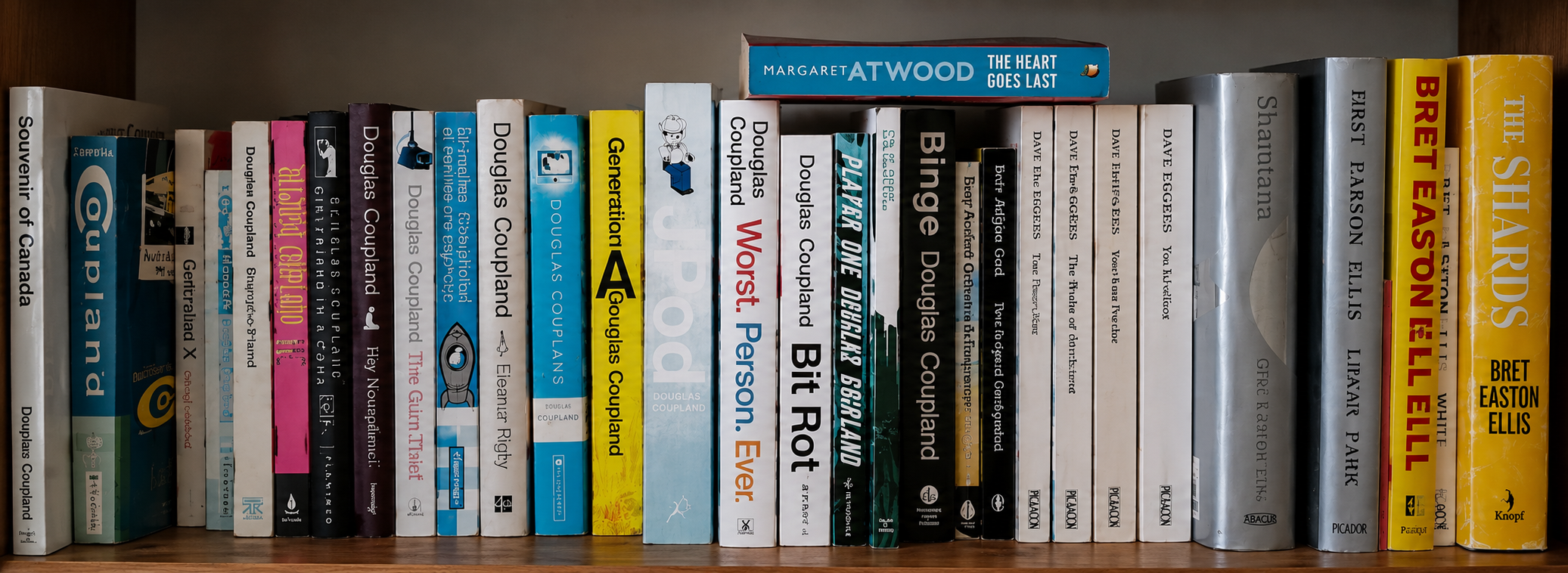
One shelf. Not all my shelves.
Last time on having fun with PhD: We established that there are questions regarding who actually reads anything. The answer appears to be Women. It’s a female readership that keeps the book market floating. There are statistics to back this up. Nielsen Bookscan can tell you more about that. But the interesting angle I picked up was that the author Jonathan Franzen and Oprah Winfrey opened up a can of worms when Franzen said that he believed an endorsement from Oprah would put off male readers. The discussion that followed went on to see both sides not bat an eyelid when it came to who reads what. General fiction, literary fiction, was not for male readers.
This is all about perception of readers. Franzen had been vocal about his discomfort with any association with the Oprah Book Club (OBC). Most importantly, for my studies, this was the first time anyone had publicly questioned what it meant to be an Oprah book. The upshot of it all was for Oprah to basically say, “Well, sorry for making you feel awkward. Your book is no longer an OBC book.” So, both sides clearly had an idea that there were types of books. No one was saying what these types are. What categories were we dealing with here? Specifically, the OBC debate came down to three things. Do men read fiction if it’s Oprah backed? Does being backed by Oprah put any value on whether your book is considered highbrow or lowbrow? Do men read at all?
Kathleen Rooney, in her book – Who would win in a fist fight between Jonathan Franzen and Oprah Winfrey? had this gem to quote.
“From its inception in September 1996, OBC was commandeered as a rallying point around which both cultural commentators and common people positioned themselves in perpetuation of America’s ongoing struggle of highbrow versus lowbrow. Both sides made reductive use of the club to galvanise themselves either as populist champions of literature for the masses or as intellectual defenders of literature from the hands of the incompetent.”
Ok, that’s not the name of the book. I’m just revelling in not having to be academic about it anymore. It was, Reading with Oprah by Kathleen Rooney. The most obvious reaction I’d have to that is that it doesn’t have to be so binary. This isn’t The Matrix of reading. It’s not - take the red pill and understand all of literature or take the blue pill and remain a literary idiot.
The terms highbrow and lowbrow are referred to without definition. I believe this helps to highlight that many critics were working without a definition, working with assumptions about the reading public and about different categories of books.
It’s only through assumptions that the debate somehow linked OBC books to both female readership and lowbrow works of literature. Although no discussion was to be had on the television show about who an OBC reader was, authors were clear in their views of who read their books. Where the argument had previously been carried by academics and booksellers it was now debated in the mainstream media and finding audiences in the New York Times and People magazine.
The lack of contention regarding gendered readership was most revealing, with it being hard to find a comment refuting that an OBC reader was predominantly female. It is worth noting that inadvertently, almost as a by-product of the discussion, many comments revealed an unquestioning, although unproven, understanding of the types of books read by different types of reader. Authors readily identify who they knew their readers to be. No comment was offered with regard to a reliable way to measure who reads which books and who enjoys them or regularly buys them. With a lack of evidence of real readers to draw on, all we are left with is assumptions of who we perceive a reader to be. This is where I coined the phrase, “Perceived reader.”
I remember an hour-long debate with two academics, one being the head of department, where we discussed “readers.” What did we mean by this? Good question and I’d got to a point where I realised that actual readers were never going to be the answer. You’d never get a big enough sample of readers to make any meaningful conclusions and even if you could I don’t know what questions you could ask that would get you useful answers. You can ask if they enjoyed the novel. You can ask if they’re male or female. You can’t ask if they feel that being male or female contributed to liking the book. Any responses to that line of questioning can only gather vagaries of perceptions, guesses as to what men and women like to read. So, after an hour of debate it was agreed that “maybe we don’t look at actual readers.” I never wanted to in the first place. And everyone had to live with the idea that people, authors, critics, essayists, students and Oprah and particularly publishers and booksellers, based all decisions on a “perceived reader.”
The recurring argument we can see is that it was acceptable for Winfrey to promote women’s books about women’s issues because that was who her readers were. Not only was this assumed to be the case but there’s statistical evidence to back it up. It was assumed to be the accepted and unchallenged norm. This is what makes Franzen’s questioning of types of reader so important.
Was The Corrections an OBC-type book? Did it fill certain criteria to be a certain type of book? We can see that before becoming an OBC selection The Corrections had already received reviews. The New York Times review can be seen to be making assumptions of the type of reader that will read Franzen and the type of author that Franzen is. Thomas Pynchon, William Gaddis, Phillip Roth, Don DeLillo and David Foster Wallace are all referred to in the review. It cannot be ignored that they are all male authors, and it cannot be ignored that they are regarded as challenging reads. To this day I only have a vague idea what’s going on in Pynchon’s Gravity’s Rainbow and to get a grasp of David Foster Wallace’s Infinite Jest I ended up going online and finding a Lego version of the events of the book. Some guy had his kid make scenes of the book using Lego and Lego characters.
Clearly, we have two perceptions of Franzen’s work. The New York Times review is at loggerheads with the OBC take on the book. An OBC book may often have specific content that a female reader may be expected to identify with. And although it is stated by the show’s producers that any book can be chosen as an OBC book and anyone can be an OBC reader, the one factor that is commonly repeated is that an OBC book is deemed so because it will appeal to an OBC reader.
And now I feel like the argument is a dog chasing its own tail.
An OBC novel could be for anyone, as long as that anyone was a female reader? Coz, women do all the reading, right?
The New York Times seems to disagree and draws heavily on associating Franzen’s work with other novelists it deems to be similar. This can be viewed as an elitist way of looking at things since it closes off readers unfamiliar with those other novelists. On the one hand the reader is encouraged to think about how they feel about the book, with little expectation of any literary knowledge and on the other hand the reader is expected to have a wider knowledge of authors. OBC does not overtly treat readers as being familiar with reading whilst the New York Times, regardless of how well read any reader may in reality be, does. Put simply, one idea of the reader is knowledgeable and the other isn’t. By choosing the ways to promote the book and choosing the points of reference made in each case an effort is made to appeal to the profile of a perceived reader or viewer, and no concession is made to the other type of reader. In both cases the reader or viewer is made to fit the profile of an OBC viewer or New York Times reader by simply ignoring that there is any other type of reader and not concentrating on any elements that fall outside of the scope of the chosen perceived reader and being selective in how they inform.
The whole debate is centred on ownership of readership based on a perception of who we think a reader is. I’m not as damning of the idea as you’d think, because a writer does have some idea how he wants to be perceived and part of that seems to lie in the notion of who reads you. More to the point is that, as a writer, with the writing at the centre of all you are doing, there doesn’t need to be any ownership of readers, at least not exclusive ownership. That was my most important aspect to drive home. Looking at the Franzen debate first of all, the first thing you need to do is ignore what the actual debate was about. Was this an OBC book? There is no way of answering that. At least there is no empirical measure to tell you exactly how much of an Oprah book it was. It’s redundant to ask it. Some academics, because they were English Literature academics, wanted me to unearth in the novel some sort of proof as to who the novel’s intended reader may be, as though the answer lay in the pages of The Corrections. You could take from now until Armageddon and not get an answer to that. To suggest going looking for that evidence in the text is to miss the point entirely. I could only imagine the nightmare of trawling through the novel trying to find something that would appeal to a New York Times reader or to someone who watches The Oprah Winfrey show. Whatever you would find could only be opinion. The real investigation is into why anyone thought that there was a definitive type of reader, one they simply assumed existed. The perceived reader, that is purely a marketing construct.
Next time: What the hell is a book club anyway?
Liked this? Continue the Series Here.
Where Next?
If you want to explore how the labels we give ourselves can become harder to escape than the labels other people give us, read Once a Geek, Always a Geek.
If you want to explore why the best writing finds its audience by being honest rather than by trying to appeal to one, read The Noise Coming From Philippe.
If you want to explore another way we decide who books are supposed to be for before anyone has even started reading them, read The Margaret Atwood Appreciation Society.
If the writing resonates, stay with it.